Water Justice and Peace
Latin American Observatory
Exploring the notion that fostering peace is as important to sustainable development in the Amazon basin as other equally important educational initiatives for long-term social justice and ecological flourishing.
0
Global Affiliates
0
Global Partners
0
Total Projects
The River (El Rio)
Advancing Peace and Forest Conservation
The initiative addresses two key challenges: supporting peacebuilding at the national and Amazonian regional levels, and providing scientific, cultural, and institutional support to help Latin American countries advance efforts to eliminate Amazon deforestation in line with the Paris Climate Agreement.
Foster Peace
To be instrumental in the consolidation of peace at the national and Amazonian regional level.
Provide Support
To provide the scientific, cultural and institutional support in Latin America for countries to comply with the 2015 Paris commitment of zero deforestation of the Amazon by 2020.
Amazonian Ecosystems and Communities
With the growing environmental degradation of rivers and forest in the Amazonian region, which will be the initial focus of the Observatory, researchers will study the consequences of globalized modern economic practices, debates on the environmental losses and the need to prepare teachers with ecologically sound pedagogical initiatives in the region.
Impacts of Globalized
Ecological Sustainable
Environmental Degradation
Documentary Film
The River (El Río)
The River (El Río) is a documentary film by Juan Carlos Galeano. The film is a journey, both mythological and affectionate. Spectacular images bring the audience’s attention to ecological wisdom about the spiritual belief systems of Amazonians.
Universidad de la Amazonia, Colombia
The Peace Office, the School of Education, the Agroecological Engineering program, and other important academic programs at Universidad de la Amazonia, Colombia, will play a key role in Observatory activities that will engage professors and students in the building of sustainable and equitable models of development for the Amazon.
Global Academic Partnerships
In addition, the Universidad de la Amazonia, Colombia, is developing academic relationships with scholars, artists and academic institutions around the world, including those at Florida State University, Florida, Westminster College, Utah, and Arizona State University, Arizona.
-

Florida State University
-

Westminster College
-

Arizona State University
Collaborative Environmental Education in Amazonia
Observatory Convener Juan Carlos Galeano, a poet, essayist and filmmaker, and professor at Florida State University, is coordinating activities between partnering institutions. Activities will include lectures, work to build collaborations with area environmental writing and eco-cinema education involving professors and students, and community outreach from the Universidad de la Amazonia to the general population.
-
International Collaboration
-
Environmental Writing
-
Eco-Cinema Education
Observatory Affiliates
Community members, researchers and scholars.
Rafael Chanchari Pizuri
Born in the Peruvian Amazon, Rafael Chanchari Pizuri is a philosopher and Amazonian from the Shawi ethnic group, whose spiritual ecological discourse, rooted in indigenous cosmovisions of the indigenous cultures of the Peruvian Amazon, foregrounds the current environmental challenges and complex symbolic narratives of indigenous Amazonians. He is also a shaman and teacher, who has contributed significantly to the education of indigenous bilingual teachers of many ethnic groups in the Zungarococha Formabiap school in Iquitos Peru.
Herman Vladimir Ruíz Abecasis
Herman Vladimir Ruíz Abecasis is a Peruvian biologist, born in Loreto, with extensive experience in the evaluation of biological diversity, and practice in the management of natural protected areas by the government in the Peruvian Amazon. As an environmental specialist, Abecasis has worked in the development of scientific reports, and environmental impact assessments in connection to oil drilling in the Amazon basin. He has done extensive work with communities in the interior of the Pacaya Samiria National Reserve, implementing programs of environmental education and natural resource management, for the sustainable use of flora and fauna in Peruvian national reserves. As a biologist he has also worked as an Environmental Specialist of the Pacaya Samiria National Reserve and, and for Pronaturaleza, he has worked as coordinator of the project “Strengthening of Tourism Management and Management of Natural Resources in the Pacaya Samiria National Reserve”. In regards to the assessment of water systems of Amazonia, Abecasis wrote the book article “Amazonia: Looking for the Earthly Eden and Finding the Planet’s Next Landfill” (Ecological Crisis and Cultural Representation in Latin America, Lexington books, 2016) along with the Colombian biologist Diego Mejía and Juan Carlos Galeano. Through his career in Perú, Abecasis has held positions in public and private institutions, gaining experience not only in natural resources, but also in the management of human resources as he has served as head of the National Reserve of Pacaya Samiria National Reserve in the Amazon basin. He is currently director of the Alpahuallo Mishana Reserve in the Peruvian Amazon.
Gisela Heffes
Gisela Heffes is Professor of Latin American Literature and Culture at Rice University and Research Professor at Johns Hopkins University as well as a writer, ecocritic, and public intellectual with a particular focus on literature, media, and the environment in Latin America. Her most recent publications are the co-edited volumes The Latin American Ecocultural Reader (2020), Pushing Past the Human in Latin American Cinema (2021), Un gabinete del futuro (2022) and Turbar la quietud (2023); the authored monograph Visualizing Loss in Latin America: Biopolitics, Waste, and the Urban Environment (2023); the novels Ischia (trad. from Spanish, 2023) and Cocodrilos en la noche (2020; 2023), the bilingual poem collection El cero móvil de su boca / The Mobile Zero of Its Mouth (2020) and the hybrid book Aquí no hubo ni una estrella (2023). With George Handley, Heffes served as co-president of ASLE, the Association for the Study of Literature and the Environment (2022-2024).
Gerardo Antonio Castrillón
Gerardo Antonio Castrillón, President of Universidad de la Amazonia, in Florencia- Caquetá, Colombia, is a political and academic leader of the Colombian Amazon region and a public accountant. Since the beginning of his administration in 2017 Castrillón has helped the University to become a strong contributor to the reinforcement of peace and the development of a sustainable human development model for the national and continental Amazon. As a leader of the Universidad de la Amazonia, Castrillón plays a big role in the consolidation of the Peace Agreements signed between the FARC (Arm Revolutionary Forces of Colombia) and the Colombian State. His role as president of the university is vital in opening spaces for social research and applied sciences that aim to generate alternatives of sustained use of the Amazonian ecosystems and defending the rights of indigenous peoples. President Castrillón’s leadership has contributed to the development of programs of academic excellence, and advocacy for harmony with the environment in compliance with the environmental commitments entered into by Colombia at the Paris Summit (2015), specifically the commitment for reduction to zero of the logging of tropical rainforest in the Colombian Amazon. The 22 academic programs of the University have defined concrete goals of pedagogical transformation towards the culture of peace and promotion of sustainable human development. Castrillón is a public accountant, specialist in tax management and magister administration. During his years of administration in the Colombian Amazon, he has served as a Governor of the State of Caquetá (2009), State Comptroller (1998-2000), Treasury Secretary of the State of Caquetá (2008-2009) and director of The Chamber of Commerce of Florence-Caquetá (2004-2006). As an academic, in addition to being the President of the Universidad de la Amazonia, he has been Dean of the Faculty of Accounting Sciences, member of the Superior Council of the Universidad de la Amazonia and a professor of the same from 1983 to the present.
Jorge Pulecio
Jorge Reinel Pulecio Yate is a Colombian economist, peace advocate and writer born in the Colombian Amazon. Obtaining his degree in economics from Universidad Nacional de Colombia, and degrees from University of Campinas – Brazil and University of Andalucía –Spain, Pulecio worked as professor of economy at Universidad Nacional de Colombia for over two decades, publishing many articles concerning international economy. Among many political and administrative positions he served as an economy analyst for the The United States-Colombia Trade Promotion Agreement (CTPA) until 2007, and as a secretary for the office of development for the mayor of Bogotá in 2012. Growing up in the rural areas of the Caquetá river region of Amazonia, in the early years of his political career he participated in the peasant and union movements during the 70’s and 80’s. As a Secretary of Education of the state of Caquetá during 1982-1983, Pulecio advocated for indigenous rights to education and the training of bilingual indigenous teachers for schools of Huitoto and Coreguaje indigenous nations. During the years 1978-1984 he created the first ecology group at the Universidad Surcolombiana, an environmental initiative that implemented reforestation in the banks of the Dedo and Yuca rivers neart Florencia-Caquetá. The publication of his collection of short stories Amor y guerra en el Amazonas (Love and War in the Amazon) in 2015, brought national attention to Pulecio as a talented writer. His book gives powerful testimonial accounts of kidnappings, massacres, assassinations and suffering experienced by Amazonians during the “dirty war”, a conflict that involved peasants, students, members of unions, drug dealers, paramilitary groups and the military forces during the 70’s and 80’s in the Caquetá area. In 1998 he was a candidate for the presidential election of Colombia representing the independent group Amazonia Viva Es Colombia Viva. Recently his work surrounds advocating for human rights in the Colombian Amazon during the process of peace and agreement between the Colombian government and the FARC. Pulecio is currently serving as director of the Peace Office at the Universidad de la Amazonia en Florencia Caquetá where he is implementing programs in education for peace and environmental justice in the Colombian Amazon.
Dr. Figuero-Helland
Leonardo E. Figueroa Helland (PhD) is an Associate Professor of Environmental Policy and Sustainability Management at The New School. He leads the Indigeneity, Decolonization and Just Sustainabilities section of the Tishman Environment and Design Center. He is a mixed-blood scholar (Indigenous Mesoamerican and Euro-America) whose work underlines how Indigenous resurgence, decolonization and the revitalization of biocultural diversity, alongside social, environmental and climate justice movements, are vital to overcome planetary crises. Building and extending beyond his doctoral work on Indigenous Philosophy and World Politics, his latest writings appear in the Journal of World Systems Research, the journal Perspectives on Global Development and Technology, the volume on Social Movements and World-System Transformation, and the volumes on Anarchist Political Ecology and on Contesting Extinctions: Decolonial and Regenerative Futures. He is currently working on a manuscript titled Indigenous Resurgence beyond “Anthropocene” Collapse: From Planetary Crises to Decolonization.
Vera Coleman
Vera Coleman is a Continuing Lecturer in Spanish at Carleton College in Northfield, Minnesota. Her research explores the convergences of gender, class, ethnicity, and the environment in Latin American cultural production from interdisciplinary perspectives drawing on multispecies ethnography, material ecocriticism, and queer ecology. She has received awards for her scholarly work from the Asociación Internacional de Literatura y Cultura Femenina Hispánica (AILCFH), Feministas Unidas, and the Association for the Study of Literature and Environment (ASLE). Her articles have appeared in the journals Gestos, Confluencia, Letras femeninas, and Interdisciplinary Studies in Literature and Environment. She is currently working on a book project titled “Beyond the Anthropocene: Multispecies Encounters in Contemporary Latin American Literature, Art, and Film,” which examines multispecies relationships in twenty-first century Latin American cultural expression while uncovering indigenous and other-than-dominant epistemologies about human-nonhuman entanglements. She is co-founder and Production Manager of the digital humanities project Latam-Films, a bilingual website with critical resources on Latin American women filmmakers.
Abigail Pérez Aguilera
Dr. Abigail Pérez Aguilera researches and writes about contemporary Indigenous movements, literature written by women of colour and its connections to environmental social movements, forced displacement, gender violence, and global politics. Her most recent work appears in Ecocriticism and Indigenous Studies: Conversations from Earth to Cosmos (ed. Joni Adamson and Salma Monani; Routledge, 2017). She is currently teaching at Westminster College in Salt Lake City, Utah.
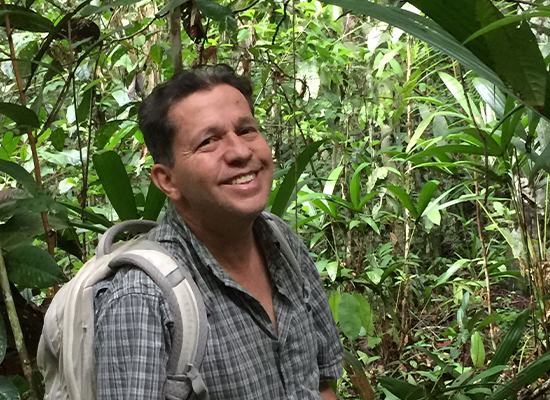
Juan Carlos Galeano
Juan Carlos Galeano is one of the Conveners of the South American Observatory of the Humanities for the Environment network. He is a poet, essayist and filmmaker born in the Amazon region of Colombia. He has published several books of poetry, and has translated the works of North American poets into Spanish. Over a decade of fieldwork on symbolic narratives of riverine and forest people in the Amazon basin resulted in his production of a comprehensive collection of storytelling (Folktales of the Amazon, ABC-CLIO, 2008. Cuentos amazónicos 2016) the documentary film (The Trees Have a Mother, Films for the Humanities and Sciences, 2008) His poetry inspired by Amazonian cosmologies and the modern world (Amazonia 2003, 2012, Historias del viento 2013, and Yakumama and other Mythical Beings, 2014), has been anthologized and published in international journals such Casa de las Américas (Cuba), The Atlantic Monthly and Ploughshares (U.S.). He lives in Tallahassee, Florida, where he teaches Latin American poetry and Amazonian Cultures at Florida State University. He is the director of the FSU Service/Learning Program: Journey into Amazonia in the Peruvian Amazon rainforest.
Maria Cruz-Torres
Maria Cruz-Torres is a socio-cultural anthropologist at Arizona State University. She conducts research on the topic of gender, globalization, and the environment in Mexico, and is also involved in a National Science Foundation interdisciplinary, transnational collaborative research project focusing on the links between human and biophysical processes in coastal marine ecosystems in Baja California, Mexico.
Joni Adamson
Joni Adamson is President’s Professor of Environmental Humanities at Arizona State University. She is the Secretary General of the Humanities for the Environment Network and Director of the North American Observatory. She is the author and/or co-editor of American Indian Literature, Environmental Justice and Ecocriticism (University of Arizona Press, 2001), The Environmental Justice Reader: (University of Arizona Press, 2002),m American Studies, Ecocriticism, and Ecology (Routledge, 2013), Keywords for Environmental Studies (New York University Press, 2016), Ecocriticism and Indigenous Studies—Conversations from Earth to Cosmos (Routledge 2017) and Humanities for the Environment (Routledge 2017). She lectures internationally and has published over 80 articles, chapters, blogs and reviews. Her work has been supported by many awards and grants, including most recently, the 2019 Benjamin N. Duke Fellowship at the National Humanities Center in North Carolina. In 2012, she served as President of the world’s largest environmental humanities organization, The Association for the Study of Literature and Environment (ASLE).
10th Anniversary Celebration and Seres Puentes Award Ceremony
We celebrated HfE’s 10th Anniversary and attended a poetry reading by Juan Carlos Galeano. During the event, Professor Galeano was presented with the 2024 Seres Puentes Award. This award, which translates from Spanish as “bridge beings,” recognized his service to the arts and humanities and to social and environmental justice on behalf of humans, animals, plants, and all living things.