Format: Quote

It is possible to see something your whole life and never really see it.

Things that are extremely common and visible everywhere seem to be the most invisible.  Take for example the plethora of meat products we see every day in the grocery store, at restaurants, in our fridges, and in numerous adverts around the city, in magazines and on television, radio and the Internet.

Meat in a grocery store. (Photo by Tracy Timmins)

How many of us have stopped to think about what meat is?  As city dwellers, we seldom, if ever, ask ourselves which particular animal we are eating, what was their life like, how were they killed, how did their bodies end up on our plate, and who were they?  Most of us have no conception of the individual cow, pig, chicken, fish, turkey, or sheep whom we are eating. The difficulty of thinking about and talking about the animal in a piece of meat is because the subject has literally vanished in the deconstruction of their body into an object for consumption.  Carol Adams (1990) in the Sexual Politics of Meat refers to the missing subject of meat as the absent referent.


What or Who is Meat?

Who are cows?
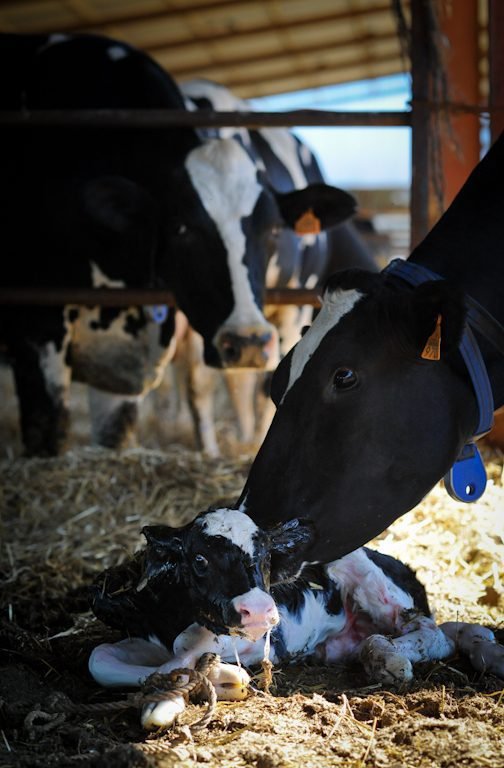
Dairy cows, who have had their calves taken away, watch as the new mother cleans her baby. (Photo by Jo-Anne McArthur for We Animals / Animal Equality)

Cows, whether they be used for beef or dairy, are of the species Bos taurus. They are herd animals and are therefore very sociable, a fact which probably made it possible for humans to domesticate their ancestors, the aurochs, in the Middle East around 12,000 years ago[1]. Cows can live up to 20 years, but the ones we eat are typically between one[2] and four years old[3], depending if they were bred for meat or dairy.  It might be surprising to read that dairy cows are also consumed, but once they are no longer able to produce high volumes of milk they are no longer financially profitable and sold for meat.

Cows are caring mothers. Like humans, the gestation period for a cow is nine months. When they are separated from their young, as on dairy farms, they bellow for days. Grief over a lost calf can last weeks.  A dairy cow is rebred (usually through artificial insemination) every 3 months after she calves so that she can continue to give milk. Most male calves are used for veal and some of the females may be used as replacement cows for the herd. A former dairy farmer, Peter Roberts said, regarding removing calves from their mothers, the “motherhood bond was so strong, that it had to be broken with violence. It keeps you awake at night.” ([1],p. 140). Not only are cows protective of their young, but bulls are protective of the herd.

According to Masson[1], cows have a highly developed sense of smell and get to know their calves and each other by scent. They also know the smell of death and the smell of blood. Cows are natural herbalists. When they are not feeling well they know which plants to eat and which ponds to drink from. Cows, as ruminants, have a tendency not to call out when physically hurt so as not to draw attention to themselves from predators, which tends to result in humans underestimating how much pain they might be experiencing. Like many other animals, cows have many emotions including joy, sadness, loss, worry, fear and curiosity. They also seem to enjoy music as you can see for yourself in the video below.

In the following video cows experience the joy of being let out on the pasture after winter.

Who are chickens?
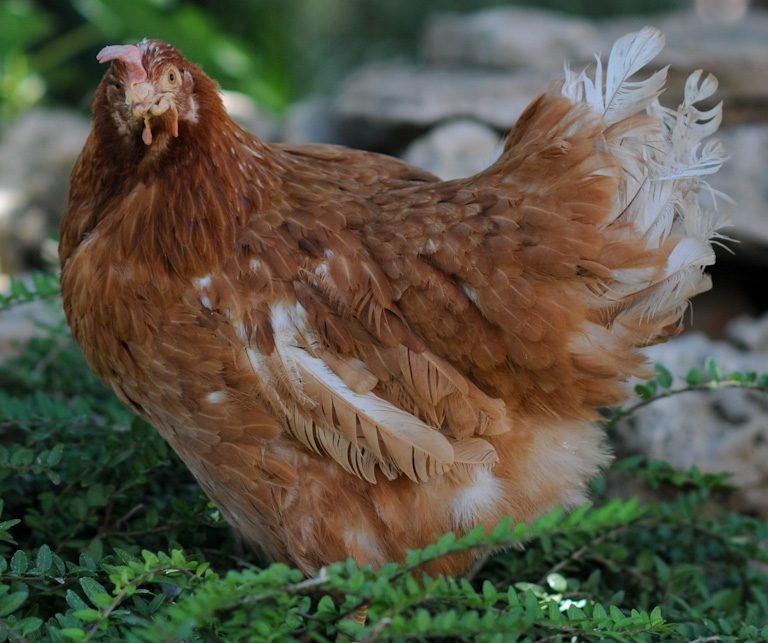
Olivia, one of 5 hens rescued from a egg farm which held over 120,000 birds. (Photo by Jo-Anne McArthur for We Animals / Animal Equality)

Chickens belong to species, Gallus gallus domesticus, and were domesticated from the Red Jungle Fowl found in Asia[4]. Chickens are probably considered one of the most non-consequential of farmed animal by city dwellers, but according to Masson, chickens have individual personalities and emotions[1]. For example, chickens derive great pleasure from dust-bathing. While dust-bathing provides an evolutionary advantage because it cleans the birds’ feathers of parasites, the motivation for doing so is clearly enjoyment. Two of the first activities that rescued barn chickens will do given the opportunity, are scratch and peck in the dust and dust-bathe. Chickens have rich communication structures and make precise calls dependent on context, whom they are addressing and who else is around [1]. Calls can indicate food discoveries, alarms, territorial claims, concern, fear, pleasure, frustration, dominance, appeasement and more.  Chickens form complex relationships with other chickens and also with humans. They are quite capable of giving and receiving affection.

Due to their small size, chickens are in fact the most exploited food animal on the planet besides fish. According to Statistics Canada, in 2012, 643 million chickens were raised for meat alone[5]. This excludes breeding chickens, layer hens and males from layer hens who are killed after hatching. Broiler chickens are typically sent to slaughter at 6 to 8 weeks of age[6], and spent laying hens at 60 weeks[7].

In the video below you can watch chickens enjoying a dust-bath.

A boy and chicken enjoy each other’s affection.

https://www.youtube.com/watch?v=sX-ib_rFvnc

Who are pigs?
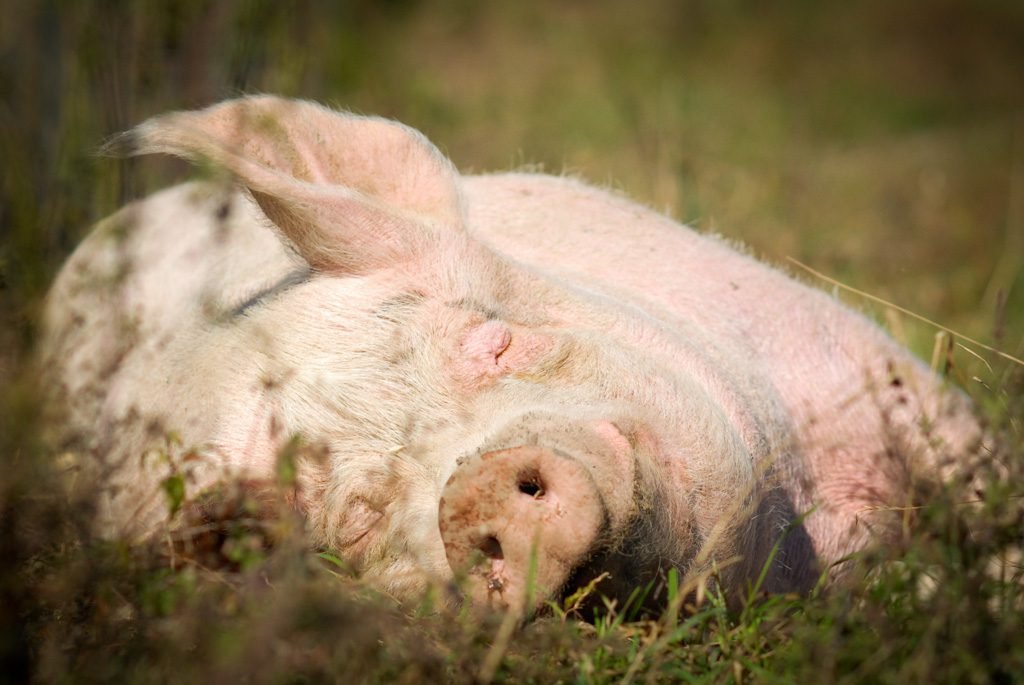
Nancy, enjoying peaceful sanctuary life. Farm Sanctuary, NY, USA. (Photo by Jo-Anne McArthur for We Animals / Farm Sanctuary)

Domestic pigs are members of the species Sus scrofa domesticus and were domesticated approximately 12,000 years ago in the Near East[8]. Despite their well-known intelligence, practically all pigs in Canada are raised in sheds on cement floors or in farrowing stalls if they are breeding sows[9].

Pigs are also generally quite reviled in popular culture as filthy, greedy and badly behaved, but it seems this is very different from their true nature according to those who have studied them or had the opportunity to interact with them on an individual basis.  W.H. Hudson, a naturalist, said of pigs,

“I have a friendly feeling towards pigs generally, and consider them among the most intelligent of beasts. I also like his disposition and attitude towards other creatures, especially man. He is not suspicious or shrinkingly submissive, like horses, cattle and sheep; nor an impudent devil-may-care like the goat; nor hostile like the goose; nor condescending like the cat; nor a flattering parasite like the dog. He views us from a totally different, a sort of democratic standpoint, as fellow citizens and brothers, and takes it for granted that we understand his language, and without servility or insolence he has a natural, pleasant camaraderie, or hail-fellow-well-met air with us.” ([1], p.18).

Esther the Wonder Pig is doing much to change the public’s opinion of pigs. Her guardians, Derek Walter and Steve Jenkins, adopted her believing she was a micro-pig, but when she grew ever-larger and larger, they soon discovered that they had adopted a “food” pig. Derek and Steve fell in love with Esther’s charming personality and have transformed their lives to accommodate her needs. They are now ardent advocates on behalf of pigs.

How can we know farmed animals?

To really know someone or something, it is necessary to develop an intimate, embodied and personal relationship with that being or thing through regular close contact and interaction, and by paying attention. Most of us who live in cities seldom have the opportunity to do so with farmed animals, but we can partially learn about farmed animals by reading or watching  stories about them and watching videos of their behaviour and interactions with others.  Ethologists (scientists who study animal behaviour in non-laboratory conditions) can also tell us a lot about what farmed animals are like, and their emotions and behaviour. Many cities have farm sanctuaries nearby where people can actually meet farmed animals in relaxed circumstances.  Near to Toronto and in Ontario there are several sanctuaries for farmed animals including Wishing Well Sanctuary,  Cedar Row Farm Sanctuary , Haven of the Heart, Refuge RR for Horses / The Canadian H.E.A.R.T, and Ruby Ranch Pip Sanctuary.  Few people know, however, that they also have an opportunity to see and interact with farmed animals within the city.  A little known fact is that urban areas have historically been the centre of slaughter operations because of the availability of infrastructure, markets and labour[2]. When animals are transported to slaughter in the city, citizens have the possibility of interacting with them in their final hours.


Slaughterhouses in Toronto

A pig slaughterhouse in downtown Toronto that closed in 2014. (Photo by Tracy Timmins)

Until recently, Toronto, was the Canadian centre for meatpacking operations and the distribution of farmed animals for slaughter[2]. Although the number of slaughterhouses in Toronto is decreasing, there remain several in existence.  Modern city dwellers are increasingly sensitive to the sight (and smell) of slaughter, and no longer imagine farmed animals as having a place in the city. As a result, slaughterhouses are increasingly located further away from the core of urban areas and hidden from public view[10]. Large-scale and modern slaughter operations also have larger space requirements which makes it more economical to purchase land outside of urban areas. Despite the scale of slaughter operations, they manage to remain in relative obscurity from the Canadian public. Canadians do not generally seek employment in the day-to-day operations of slaughterhouses and meatpacking plants, therefore, workers involved in killing and processing animals typically come from marginalized and immigrant groups (see here, for example). The meat industry itself has stated that it cannot recruit sufficient Canadians to fulfill their need for workers at slaughterhouses[11]. Canadians, usually white, are however, employed as plant managers, marketers and truck drivers.

A chicken slaughterhouse in northwest Toronto. (Photo by Tracy Timmins)

Slaughterhouses are located out of sight. They have high walls, fences, no or few windows and other means of hiding what is happening inside.  Pachirat (2011), in Every 12 Seconds, Industrialized Slaughter and the Politics of Sight, argues that

“distance and concealment operate as mechanisms of power in modern society. Although we literally ingest its products in our everyday lives, the contemporary slaughterhouse is ‘a place that is no-place,’ physically hidden from sight by walls and socially veiled by the delegation of dirty, dangerous, and demeaning work to others tasked with carrying out the killing, skinning and dismembering of living animals.” ([12], p.4)

According to Pachirat, slaughterhouses are invisible and inaccessible to ordinary members of society. For this reason, I took it upon myself to visit several slaughterhouses in Toronto and South Africa, my native country. Visiting a slaughterhouse, however, does not entail going inside, because, it is difficult to obtain legitimate permission to do so. I am not sure I would have the stomach for that anyway.

A cow slaughterhouse in northwest Toronto. (Photo by Tracy Timmins)
A large wall separating a residential neighbourhood from slaughterhouses and tannery in northwest Toronto. (Photo by Tracy Timmins)
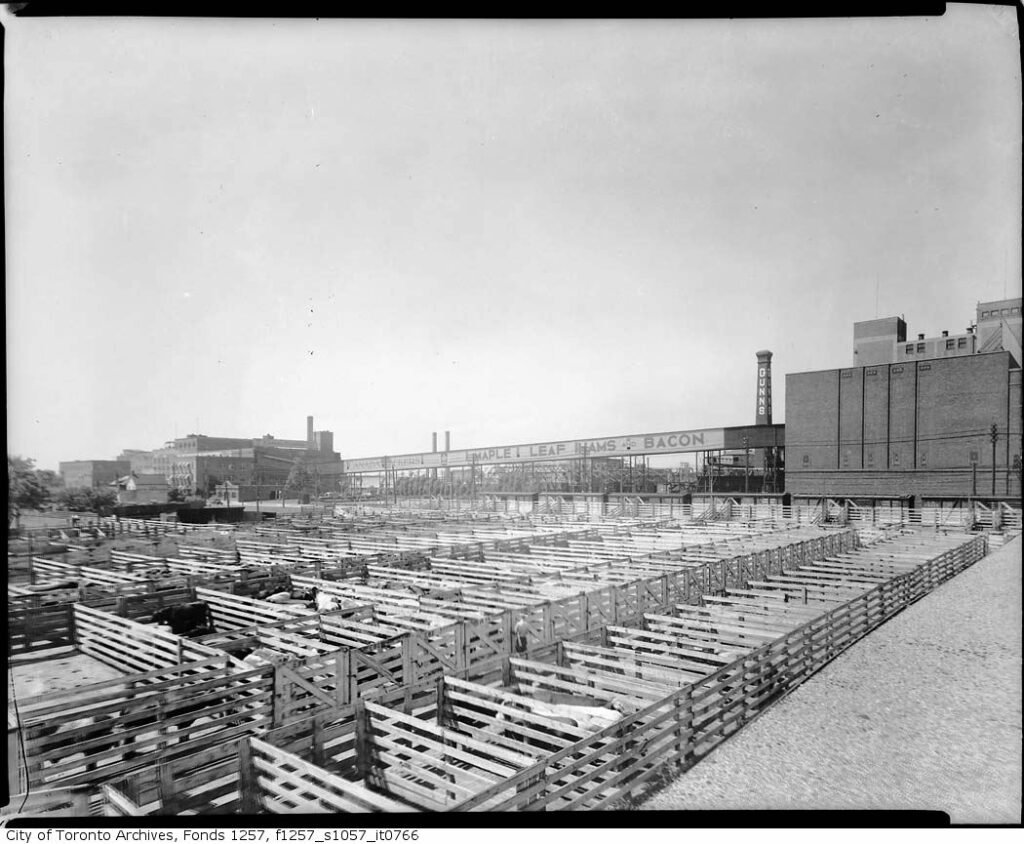
Canada Packers stock yards located on the south west corner of Keele St. and St. Clair Ave. West between 1935 & 1955 (Toronto Municipal Archives, Fonds 1257 Series 1057 Item 766)

Several of the remaining slaughterhouses in Toronto are part of the former Stockyard Industrial District in northwest Toronto. The Stockyard Industrial District was very large, being 97.6 hectares in area, and was composed of the Ontario Stockyards, a meat packing complex consisting of slaughterhouses, meat packing and processing plants, extensive railways, manufacturing, scrap yards, warehousing and other heavy industry uses, as well as pockets of residential houses and commercial use. The Ontario Stockyards was a 15 hectare portion of the Stockyards Industrial District[13].The Ontario Stockyards was located on the south side of St. Clair Street and the west side of Keele Street. The stockyards functioned as a livestock market place where animals were bought and sold daily to farmers and slaughterhouses.  While waiting for slaughter or distribution, the animals would be held in pens in the stockyards.
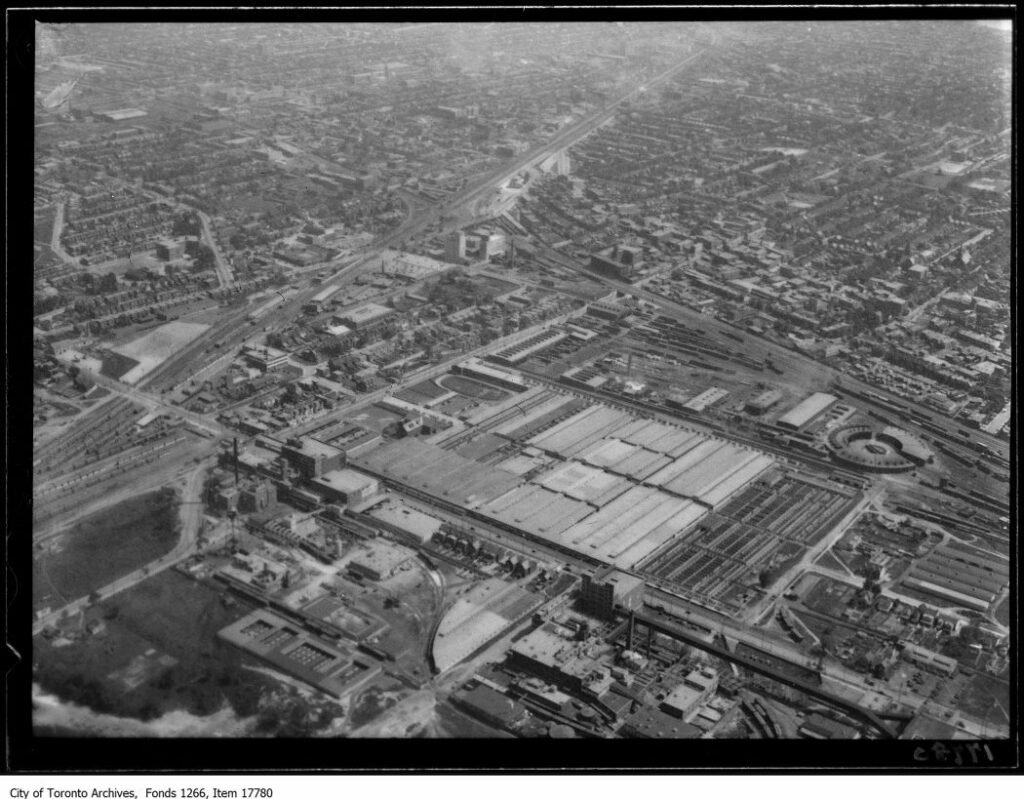
Aerial photos of northwest Toronto, the Industrial Stockyard District (formerly known as Union Stockyards), 1939. (Toronto Municipal Archives, Fonds 1266, Item 17780)

The Ontario Stockyards was opened in 1903 and closed down in this location in 1994 and moved to Cookstown where it exists to this day. The closure of the stockyards was mostly as a result of changes in how animals are distributed to slaughterhouses. In the first half of the twentieth century, animals were primarily transported to the stockyards for auction via rail, but increasingly farmers sold directly to meat packers and trucking companies transported animals directly to the slaughterhouse [2]. During its existence in Toronto, the Ontario Stockyard was one of the largest facilities of this type in North America. The Ontario Stockyard dealt in cattle, veal calves, sheep, lambs and pigs.  In 1982 it was estimated that 435,000 cattle, 122,000 calves, 90,000 sheep and 235,000 hogs were transported to the stockyards by truck and a further 60,000 cattle and 64,000 calves by rail that year.

It was the Ontario Stockyards that attracted the slaughterhouses and meat packing industries. The first slaughterhouse was erected in 1905 and was soon
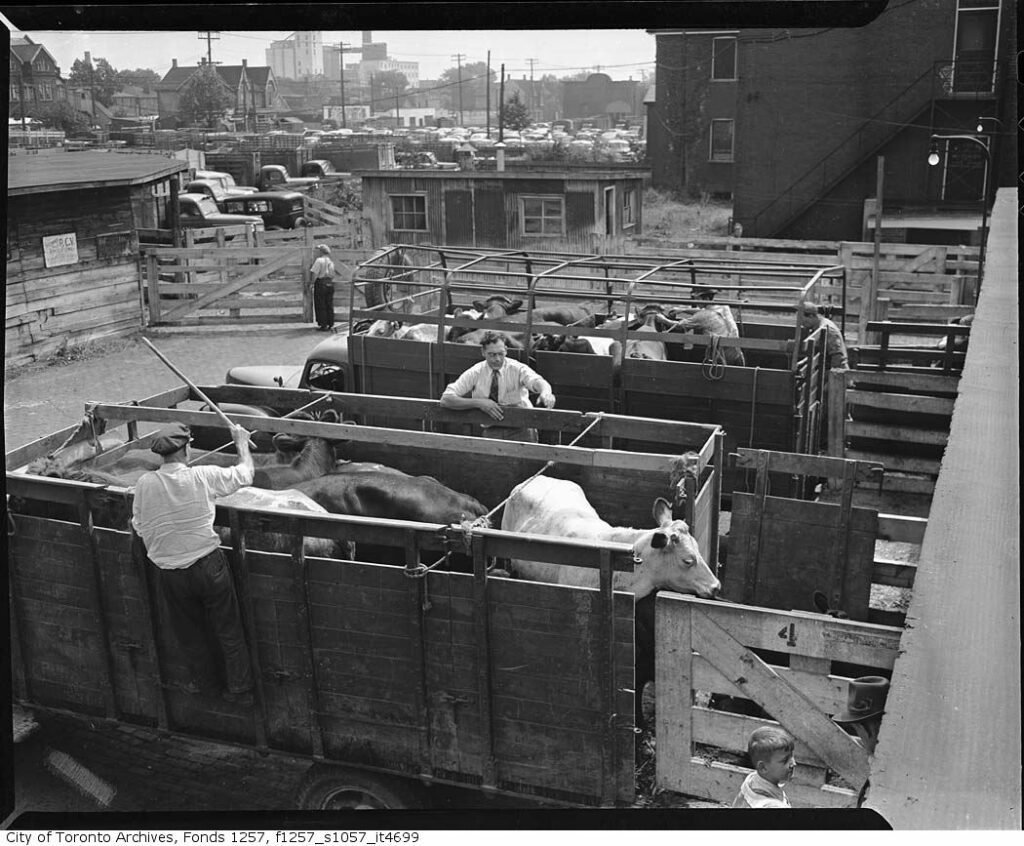
Men unloading cattle at Union Stockyards, estimated from 1940s (Toronto Municipal Archives, Fonds 1257 Series 1057 Item 4699)

followed by others.  It is little known that industrial-scale slaughtering and “dressing” has been in operation in Canada since the end of the nineteenth century [2].  Henry Ford’s automobile assembly line was in fact inspired by the disassembly of animals hanging by their hind legs from a packinghouse rail line.  According to MacLachlan ([2], p. 8), an academic geographer,”The natural animate variability in cattle and the nature of organic tissue required more labour-intensive technology than automobile manufacturing but in other respects the turn-of-the century meat-packing industry in North America was the prototype for the Fordist revolution.” (As an aside, the language used to describe living cows as having “natural animate variability” and “organic tissue” seems to be a euphemism to avoid acknowledging that cows are sentient and do not willingly go to slaughter, are messy and bloody, and refuse to be homogeneous processing units like car parts despite efforts from producers.)

The slaughterhouses that still exist in the Old Stockyards vicinity have a long history. Both St. Helen’s and the Ryding Meat Packers were at least already present in 1983 [13].  The current Maple Leaf chicken slaughterhouse is a continuation and merger of previous companies that worked in the area[2].  In a highly competitive market, St. Helen’s survives by slaughtering dairy cows and boning ungraded beef. It also serves a distinctive ethnic market ([2], p.287). Based on discussions with local activists, Ryding Meat Packers also carries out kosher slaughter.
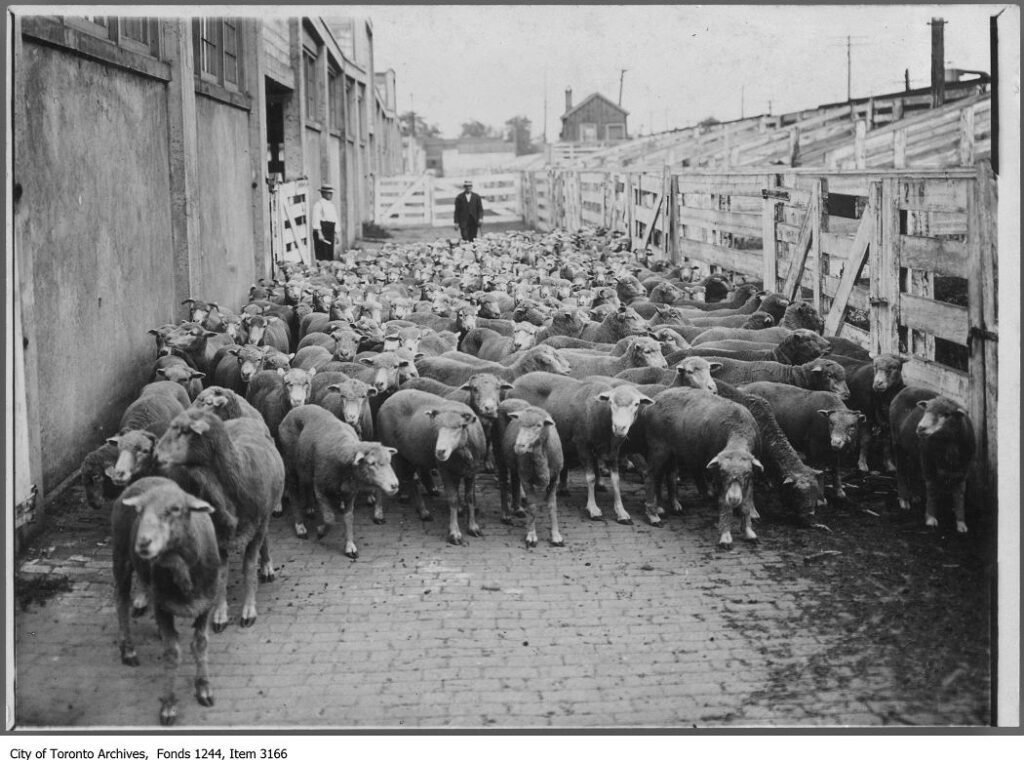
Herding animals at the stockyards in 1908 (Toronto Municipal Archives, Fonds 1244 Item 3166)
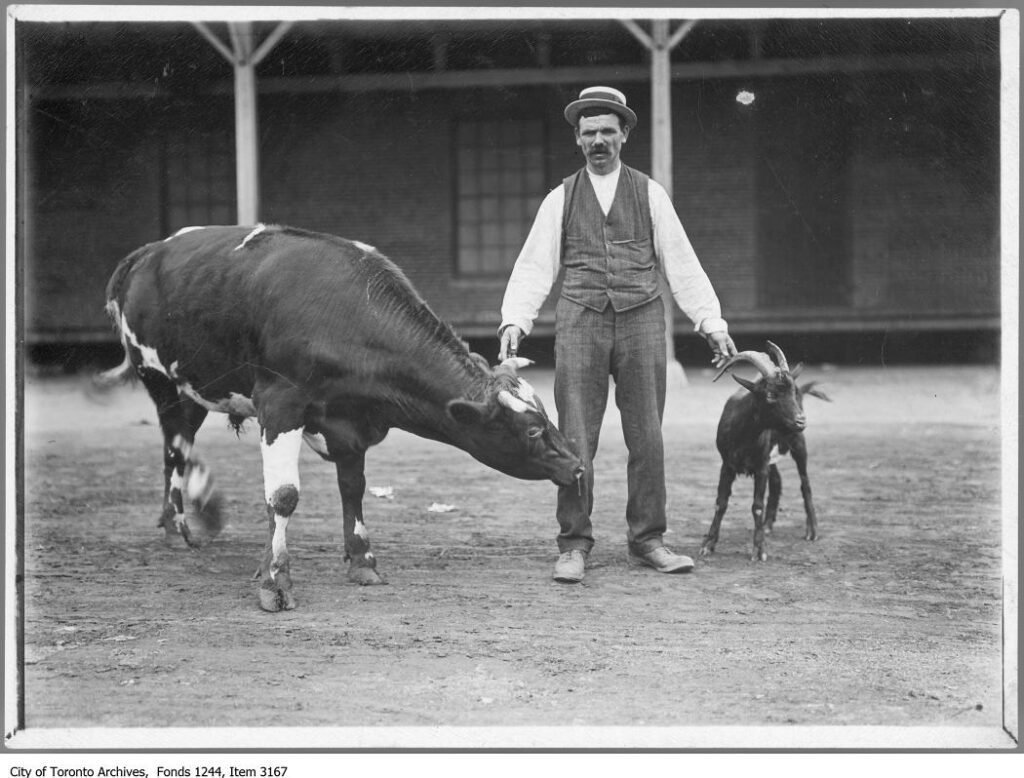
Briny the bull and Jerry the goat, leaders at the Union Stock Yards from 1909. Briny and Jerry would lead cows and sheep, respectively, to slaughter. (Toronto Municipal Archives, Fonds 1244 Item 3167)
Old Stockyards street sign – a reminder of the Ontario Stockyards in 2014. (Photo by Tracy Timmins)
The Stockyards mall in northwest Toronto – the former Industrial Stockyard Complex in 2014. (Photo by Tracy Timmins)

For the purposes of this project, I visited the former Ontario Stockyards area several times, now converted to big box stores and a shopping mall. The mall is designed to completely block the sights (and stench) of the slaughterhouses and leather tannery. Not one window or view point faces west towards the slaughterhouses and tannery. During a visit on a Sunday evening, I briefly saw a cattle transportation truck drive past on the north side of the mall, but had I not being paying attention, I would not have noticed it. I tried to imagine the sights, smells and sounds that I would have heard when the stockyards still existed and the lives that had passed through there, but it was hard.  The only reminders were the names given to a road, “Old Stock Yards Road,” and the mall, “the Stockyards”. It seems to me that there is terrible forgetting happening here before people have even realised that there is something to forget.


Art: Sirens of the Lambs by Banksy

This provocative performance street art was created by renowned artist, Banksy.  The onlookers’ attention is grabbed by the unusual sight of the toys squealing from the transportation truck.  It seems doubtful that a truck filled with living farmed animals would receive such notice.  Art can be a powerful means of making people pay attention and see familiar sights differently.


Literature: Upton Sinclair, The Jungle, 1906

In 1906, journalist and writer, Upton Sinclair published The Jungle, a novel about the working class of the United States centred around the Chicago stockyards and meatpacking industries.  His goal was to raise consciousness about the exploitation of immigrants and workers in unregulated capitalism and promote socialism as an alternative [14]. The novel was based upon Sinclair’s own investigative journalism into the stockyards and meatpacking industries and is therefore rich in realistic detail.  His description of the violent disassembly of farmed animals in the slaughterhouse was intended to act as a metaphor for the workers who were also cogs in the machine and whose lives were destroyed by capitalistic exploitation. However, The Jungle was too brutal, journalistic with a touch of soap-opera to be a work of art. Readers were disgusted by the unsanitary and horrific conditions of the slaughterhouse and missed the criticism of the capitalist system itself, resulting in the passing of the Meat Inspection Act and the Pure Drug and Food Act of 1906.  Sinclair said in an interview with Cosmopolitan magazine, “I aimed at the public’s heart, and by accident I hit it in the stomach” (Wikipedia, The Jungle). Neither the workers’ conditions nor the animals received much attention from the public who were mostly concerned about their own food safety. The slaughtered animals were, ultimately, the most overlooked by the author and the book’s readers and critics. Sinclair appropriated the violence inflicted upon animal bodies for political purposes and never seemed to question their very subjugation and destruction in the capitalist system.

“They had chains which they fastened about the leg of the nearest hog, and the other end of the chain they hooked into one of the rings upon the wheel. So, as the wheel turned, a hog was suddenly jerked off his feet and borne aloft. At the same instant the ear was assailed by a most terrifying shriek; the visitors started in alarm, the women turned pale and shrank back. [. . .] Meantime, heedless of all these things, the men upon the floor were going about their work. Neither squeals of hogs nor tears of visitors made any difference to them; one by one they hooked up the hogs, and one by one with a swift stroke they slit their throats. [. . .] It was all so very businesslike that one watched it fascinated. It was pork-making by machinery, pork-making by applied mathematics. And yet somehow the most matter-of-fact person could not help thinking of the hogs; they were so innocent, they came so very trustingly; and they were so very human in their protests–and so perfectly within their rights! [. . .]  Now and then a visitor wept, to be sure; but this slaughtering-machine ran on, visitors or no visitors. It was like some horrible crime committed in a dungeon, all unseen and unheeded, buried out of sight and of memory.” (The Jungle, p.36-37)


Bearing witness
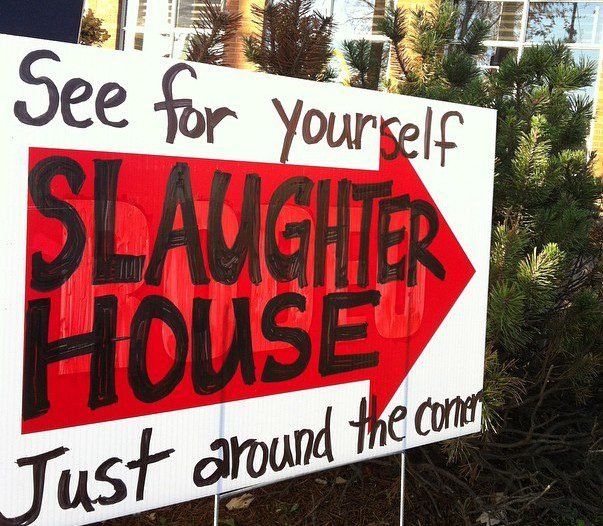
A Toronto Pig Save sign making the slaughterhouse visible from 2014. (Photo by Anita Kranjc.)

The visibility of the slaughterhouses in the Old Stockyards district began to change in 2012 when it was first visited by a grassroots animal rights group in Toronto called Toronto Pig Save. The group, a loosely connected set of individuals that grows, swells and changes over time, believes in the power of bearing witness to transform the viewer’s heart through the connection created with those who are suffering. Toronto Pig Save began doing vigils at a pig slaughterhouse, Quality Meat Packers, in 2010 and expanded to include other slaughterhouses in the region. Weekly vigils occur within and outside of Toronto. The movement has become international with many similar groups arising all over the world. Toronto Pig Save’s welcoming tone and online presence allows them to connect with members of the public, many of whom are meat eaters who noticed the transportation trucks in the city and were disturbed by what they saw.

Toronto Pig Save’s mission is to make slaughterhouses and the animals who are killed in them become visible.
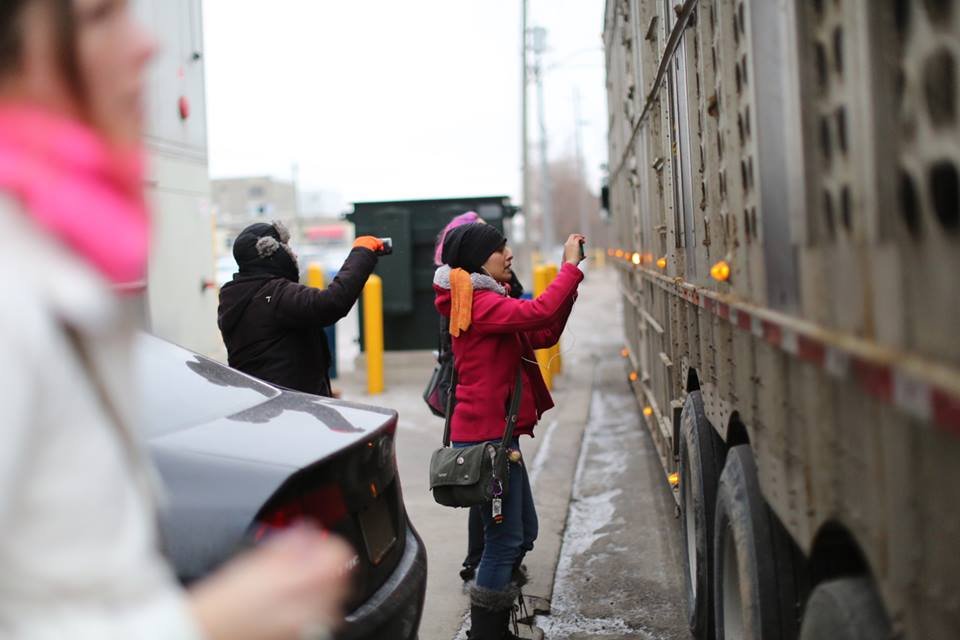
Bearing witness to a cattle transport truck in 2014. (Photo by Anita Kranjc).

“Our mission is to put “glass walls” on Toronto’s three slaughterhouses [. . .]. Our goal is to encourage people: to join us and bear witness of the suffering of animals in transport and at slaughterhouses, to go vegan, to be daily animal activists, to protect the environment, to promote healthy living, to support farm sanctuaries, and to work towards a just transition for workers and the creation of meaningful and nonviolent work in a vegan food economy.” [15]

According to their website:

“Toronto Pig Save uses the strategies of bearing witness to animal suffering in darkest places—slaughterhouses—and a community-organizing approach in which we have a team of leaders and we encourage leadership in others. We aim to build a democratic, mass-based, grassroots movement to bear witness of animal suffering, end the animal emergency, and create a world of animal equality and animal sanctuaries. We use a love-based approach informed by Leo Tolstoy (especially his book The Kingdom of God is Within You about nonviolence, love and truth as the most potent forces in life and in social change), Mahatma Gandhi, Martin Luther King, Lois Gibbs, Cesar Chavez, and many other grassroots community organizers.”[15]

I first joined a Toronto Pig Save vigil at the former Quality Meat Packers slaughterhouse (now closed) in 2012. The prospect of bearing witness to suffering and saying good-bye to animals who were going to be killed was not something I looked forward to, but I felt a need and a duty to see the animals and to confront the meat industry from which I had been sheltered. Fortunately, the Toronto Pig Save community, led by a strong and compassionate activist, Anita Kranjc, provided a supportive community which is necessary when witnessing trauma and death. It is really difficult to describe the emotional dread of seeing something that is both horrible and totally banal, in the sense that it happens every day and is very much a part of normal life. Quality Meat Packers was in a particularly odd and contradictory setting that intensified my feeling of disbelief and disconnect. It was located in a gentrifying condo-community. Opposite the slaughterhouse, were tennis courts and a large free run dog park where people would commune with their pets. The contrast of dogs happily frolicking with their companions and stinking trucks rolling by containing screaming pigs was hard to comprehend.

Pigs inside transport truck, one looking at me. The sun is shining in. 2012. (Photo by Tracy Timmins)
Pig looking at me from inside transport truck in 2012. (Photo by Tracy Timmins)

I also visited the cow slaughterhouses in northwest Toronto. I was not able to capture good photographs of the cows, but did obtain photos of freshly removed cow hides on a truck. As they were being moved a stream of blood dripped from the truck onto the side-walk and road.

Freshly removed cow hides being taken to the tannery. Nov 2014. (Photo by Tracy Timmins)
Cow blood running onto the street. Nov 2014. (Photo by Tracy Timmins)

Hannah Gregus, a young member of Toronto Pig Save, made the following compilation of vigil experiences at slaughterhouses in Toronto and nearby. Participants try to reach out to the animals. They talk to them and sometimes cry. “I see you,” and “I’m sorry,” are phrases most commonly expressed.

Ten Billion Gone – Toronto Cow Save/Toronto Pig Save 2014 by Hannah Gregus

http://youtu.be/_yV7Lr82e0E?list=UUdIRGHqOaIzbv3nDTksydQQ


How the meat industry views farmed animals

Many different actors are involved in the entire supply-chain of reproducing, growing, transporting, slaughtering, processing, packaging, distributing and marketing of farmed animals and meat. Each of the actors could have different ideas about the animals whom form the heart of their business. If we believe the marketing campaigns, all animals within their care are valued, respected and treated well.

McDonald’s has a large campaign inviting people to ask them any question about their food. Very few questions submitted by the public to the McDonald’s website seem to be about animal welfare. Rather, they are mostly concerned about food safety and disgust issues. In the following video, a rancher from Alberta describes his process of raising cattle in very reasonable terms. The animals look content in this neatly contrived video, but the farmer glosses over the repetitive breeding of cows, and the stress animals experience when branded, castrated, and dehorned, while in feed lots, and during transportation and slaughter.

On another industry site, Chicken.ca, a similar, but lower budget, Q-&-A section has been created for consumers. A customer asks, “Is it true that to de-feather a chicken it’s scalded with hot water while it’s still conscious?!” – Claire B, MB.

Chicken.ca’s response is,

“No, Claire, it’s not true. Chickens are processed in a humane way. When the chickens arrive at the processing plants, they are anesthetized with a mild electric current that makes the birds insensitive to pain. Next, the anesthetized birds are passed by a cutting blade that severs the carotid and/or jugular arteries. This whole process takes place in seconds. Later in the process, the carcass is immersed in hot water, and machines with rubber contacts are used to rub the feathers off.”

This response is dry and technical, thereby deflecting attention away from the living, breathing birds that must pass through a slaughterhouse system which would otherwise be described as horrifying. It seems odd to conclude that being electrocuted is a humane way to be killed. This technical description also assumes that the technical system always works perfectly. The fact that tens or hundreds of thousands of birds are “processed” daily reveals the impossibility of ensuring that all chickens are killed “humanely.”

In a historic case, Maple Lodge Farms in Brampton Ontario, which slaughters a staggering 500,000 chickens per day, was found guilty in September 2013 of causing undue suffering to spent laying hens and broiler chickens in transportation to the slaughterhouse in freezing cold weather. They were sued by the Canadian Food Inspection Agency (CFIA) under the Health of Animals Act. An excessively high percentage of birds were found dead on arrival (DOA) in 2008 and 2009 which prompted the CFIA to investigate. Four per cent DOA is considered acceptable for spent hens and two per cent for broilers at the time. These are not laws, only generally accepted figures in the industry. Details of the case can be found in this report prepared by the Canadian Coalition for Farm Animals (CCFA)[5]. The report documents the conditions of the birds as testified in court and is well worth reading for fascinating details about the industry. According to the report just-in-time supply-chain management and economic considerations trumped the well being of the birds.

I attended trial proceedings on 11 February 2012 and was astounded by how precisely-timed the supply-chain management system of chickens’ lives and deaths is. Chickens must be hatched at the right time, grow at the correct rate, be removed from sheds at the right time (to make space for new chickens), and be slaughtered at the right weight. For example, if the broiler chickens weigh too much in total kilograms due to being allowed to grow for too long, i.e., be alive for too long, producers (farmers) will be fined for being over-quota. One testimony from an employee of Maple Lodge Farms really stood out for me. While describing the tight schedules for managing laying hens’ lives, he referred to spent hens as a “by-product” of egg production. The value of the meat on a spent hen is approximately $1 and the estimated cost of the hen by time of arrival at the slaughterhouse is 23c/kg (whether dead or alive). Clearly, hens are not “worth” much. Spent hens are used in deli products, chicken hot dog sausages and pet food. Alternatively spent hens can be gassed, burned or sent directly to rendering plants. Judge Kastner concluded, “Regrettably, Maple Lodge Farms, through their employees and agents, decided that commercial imperatives trumped animal welfare when setting out that day to transport the spent hens to slaughter.”

The attitude to spent hens is evident in the following academic report prepared by Janet Montgomery, The Disposal of Light and Heavy Spent Fowl in Canada[7]. Quoting from her report below:

“The price for spent fowl for
slaughter is low, and often not feasible when transportation costs are considered.
Therefore, producers are concerned with improved measures of flock disposal, and
especially methods that will increase income from the use of the spent birds.

Processors may be interested in the volume and value of the spent fowl produced each
year as a potential source of income as well. Knowing the supply of birds and what
nutrients are provided by each bird in terms of protein, fat, feathers and blood can aid
them in making processing decisions for feasibility, profitability, and the type of further
processed products that would be marketable to consumers.

Society is becoming increasingly aware of animal production and welfare issues, as
well as the impact of agriculture on the environment. It would be pro-active of the
industry to find a welfare and environmentally-conscious solution for flock disposal
before it becomes a major issue to the public, and decreases the value of poultry products.” (p.3)

It is clear from above that the dominant interest is profitability. Concern over chickens’ welfare is a reaction to potential consumer disapproval, which could lower profitability.

A quick search for articles using keywords “economic” or “efficiency” in the Journal of Animal Science, reveals similar attitudes. Titles include, “Economic Value of Feeder Calves Between Breed Crosses”, “Stochastic Economic Evaluation of Dairy Farm Reproductive Performance”, “Influence of Mature Cow Weight on Economic Efficiency in Beef Cattle Production”, “Some Relationships Between Blood Group Factors and Economic Traits in Swine”, “Swine, Breeding for Efficiency,” “Feed Efficiency of Dairy Cows During First Lactation”, “The Effect of Feed Restriction on Feed Efficiencies and Carcasses of Charolais x Hereford Steers”. Whatever the industry may tell us about their relationship with farmed animals, it is clear from a casual investigation into academic literature, trade journals and actual industry practices that farmed animals are only bare life. Every aspect of their lives is tightly managed and controlled as part of the supply-chain-management process. The value of individual animal lives is subsumed in the larger scientific-capitalistic enterprise. Never do they question whether animals should be turned into commodities to be “produced”, traded and consumed, and it is not in their interests to do so.


Literature: Charlotte’s Web, 1952, by Elwyn Brooks White

A popular children’s books features a pig, Wilbur, who escaped the fate of being eaten thanks to the effort of his spider friend, Charlotte [16]. Charlotte wrote messages about Wilbur in her web to impress the judges at an annual pig competition. After winning a special prize, Wilbur was guaranteed to live to old age. The book anthropomorphizes animal characters to help the reader relate to them. Although the animals take on distinctly human characteristics, like being able to speak English and write, White also makes an effort to describe their natural behaviours and inclinations. For example, White describes Wilbur’s actions and feelings after escaping from the barn:

“He gave a jump in the air, twirled, ran a few steps, stopped, looked all around, sniffed the smells of afternoon, and then set off walking down through the orchard. Pausing in the shade of an apple tree, he put his strong snout into the ground and began pushing, digging, and rooting. He felt very happy.” (p. 18)

In a letter, White wrote about how he came to write Charlotte’s Web. He describes his love of animals and pigs in particular. After raising several pigs and developing relationships with them, he felt a sense of betrayal after killing them. He wrote this story about Wilbur to reflect his desire that a pig would escape its fate.

“A farm is a peculiar problem for a man who likes animals, because the fate of most livestock is that they are murdered by their benefactors. The creatures may live serenely but they end violently, and the odor of doom hangs about them always. I have kept several pigs, starting them in spring as weanlings and carrying trays to them all through summer and fall. The relationship bothered me. Day by day I became better acquainted with my pig, and he with me, and the fact that the whole adventure pointed toward an eventual piece of double-dealing on my part lent an eerie quality to the thing. I do not like to betray a person or a creature, and I tend to agree with Mr. E.M. Forster that in these times the duty of a man, above all else, is to be reliable. It used to be clear to me, slopping a pig, that as far as the pig was concerned I could not be counted on, and this, as I say, troubled me. Anyway, the theme of “Charlotte’s Web” is that a pig shall be saved, and I have an idea that somewhere deep inside me there was a wish to that effect.”[17]

Blockade
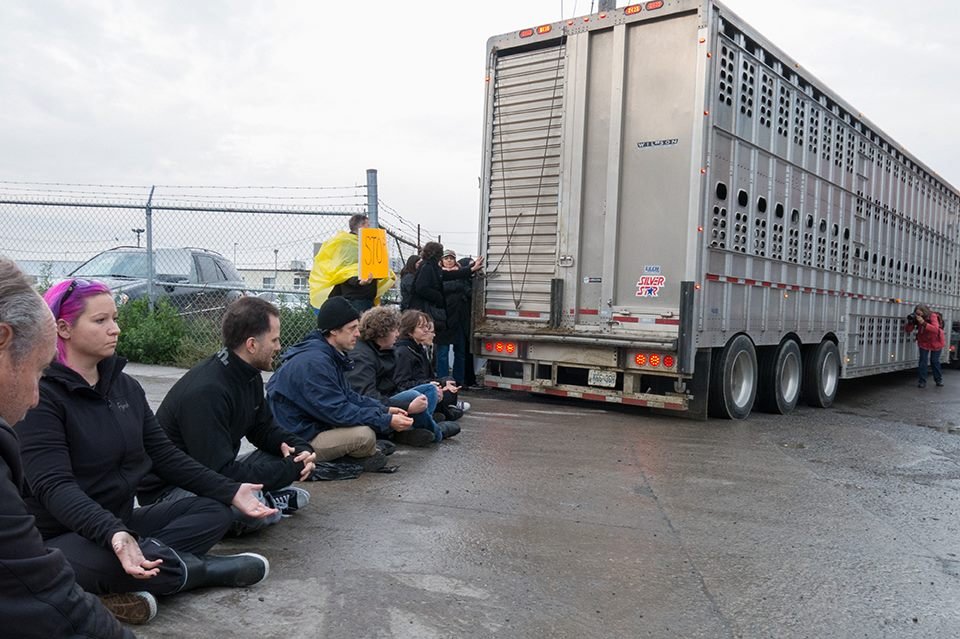
Peaceful activists block a transportation truck from delivering cows to slaughterhouse. Nov 7, 2014 (Photo by Carole Iritz)

A group of Toronto-based activists took White’s whim to save animals from slaughter seriously. So seriously that on the 6th of November 2014 they decided to take non-violent direct action against St Helen’s Meat Packers by blockading the entrance to the slaughterhouse. Six activists (three women and three men) sat on the sidewalk (public property) side by side to prevent the trucks from entering. Up to 70 Toronto Pig Save members came to support and bear witness. The blockade lasted 2.5 half hours before the activists were arrested for public mischief. According to activists, John Bonnar from Rabble News reported fairly on the event, here.

According to the activists’ media representative, Lorene Elke[18],

“We consider ourselves part of the whole blockadia movement which Naomi Klein is talking about in her new book “This Changes Everything” although she doesn’t mention specifically animal rights groups.”

“When activists are willing to use their own bodies to defend the innocent, it is meant as a highly symbolic gesture of solidarity with the most oppressed beings on the planet. It is a way to say that we will try to defend them as they go to their deaths, and that we object to this needless and cruel system of violence that is in place to rob them of their lives and their freedom.”

More information about the blockade can be found on the activists’ website, Meet Me at the Stockyards.
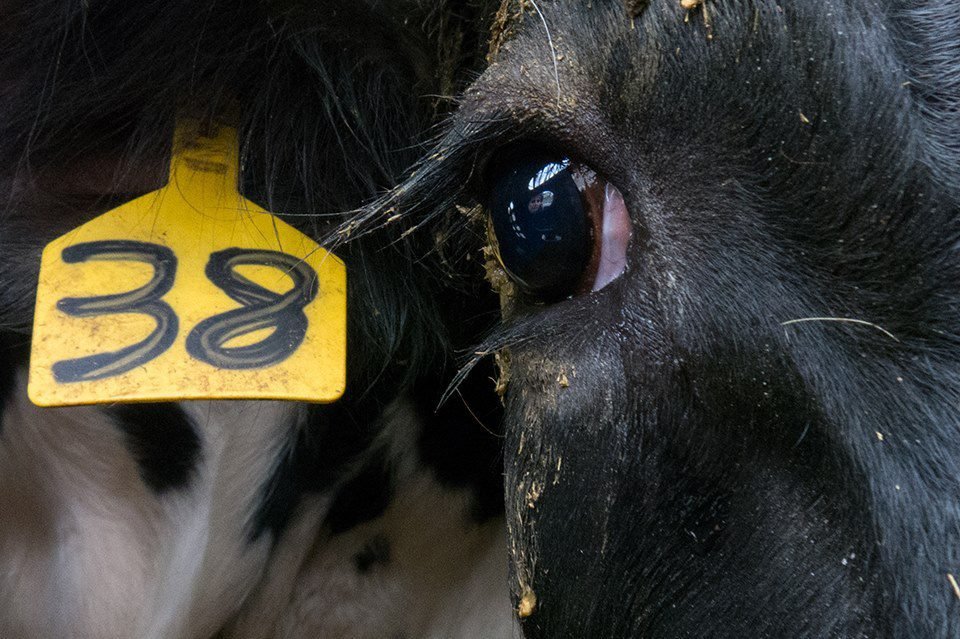
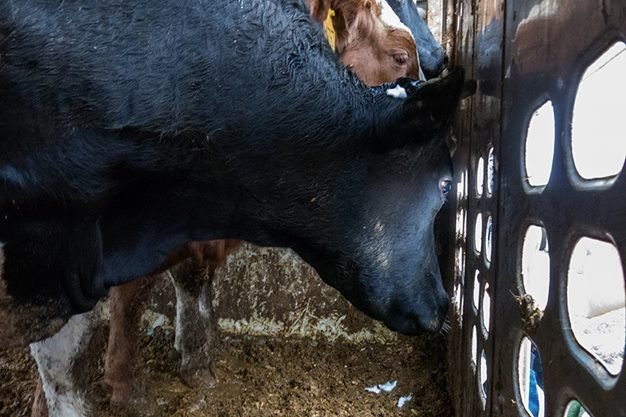
Seeing each other, activists and cows. Nov 7, 2014. (Photo by Carole Iritz)
The cows see the activists. Nov 7, 2014. (Photo by Carole Iritz)

Making life overlooked visible

The animals who are transformed into meat are both overlooked and not overlooked. The general public or consumers may not think about the meat/flesh that they are eating or the farmed animals’ lives, but the meat industry, with its farmers, transporters, meat packers, and supply chain managers spend their working hours managing every aspect of these animals’ lives. However, although all the material aspects of turning an animal into a product is thoroughly researched and controlled, sight of the individual animal and their inner world seems to be almost completely lacking. In industrial capitalism, farmed animals are bare life, infinitely disposable. Animals are grown to be more efficient, to grow faster, and to be more profitable. This is very clear in the language that is used, such as livestock, by-products, spent hens, dead on arrivals or DOAs, breeders, disposal etc. This is why throughout this text, I have attempted to refer to farmed animals rather than use conventional words such as livestock, pork and beef which prevents us from confronting the animal. Animal-centred language is a first step in trying to make the animal behind the meat more visible. Bearing witness is also essential for uncovering their lives. In bearing witness one encounters a living being who not only is seen, but sees us. In seeing and recognizing each other a profound connection is created, much like in Derrida’s The Animal That Therefore I Am (in Critical Inquiry 2002).

I would like to end with a short documentary about artist, Sue Coe, made by Our Hen House, in which Sue Coe beautifully explains the power of bearing witness and expressing images, feelings and memories through art.

https://www.youtube.com/watch?v=33971889


References

[0] Wolch, J. R., & Emel, J. (Eds.) (1998) Animal Geographies: Places, Politics, and Identity in the Nature-Culture Borderlands. London: Verson, , p.xi

[1] Masson, Jeffrey Moussaieff (2003) The Pig Who Sang to the Moon, The Emotional World of Farm Animals. New York: Random House Publishing Group.

[2]MacLachan, Ian (2001) Kill and Chill, Restructuring Canada’s Beef Commodity Chain. Tor, Buffalo, London: University of Toronto Press.

[3] Wikipedia (n.d.) “Dairy Cattle,” Wikipedia. [online] url: http://en.wikipedia.org/wiki/Dairy_cattle. Accessed on 2014 Dec 8.

[4] Wikipedia (n.d.) “Chicken,” Wikipedia. [online] url: http://en.wikipedia.org/wiki/Chicken. Accessed on 2014 Dec 9.

[5] CCFA and AAC (n.d.) Economics of Animal Welfare, Production, Transport and Slaughter of Chickens in Canada. [online] url: http://www.humanefood.ca/pdf%20links/Maple%20Lodge%20Farm%20report.pdf.

[6] Chicken.ca (n.d.) Chicken.ca. [online] url: http://www.chicken.ca/. Accessed on 2014 Dec 7.

[7] Montgomery, Janet (2005) The Disposal of Light and Heavy Spent Fowl in Canada. [online] url: http://chep-poic.ca/pdf/CBHEPA%20Reports/Janet%20Montgomery%20Final%20Report%20-%20September%202005.pdf. Accessed on 2014 Dec 7.

[8] Wikipedia (n.d.) “Domestic Pig,” Wikipedia. [online] url: http://en.wikipedia.org/wiki/Domestic_pig. Accessed on 2014 Dec 9.

[9] Sorenson, John (2010) About Canada, Animal Rights. Halifax & Winnipeg: Fernwood Publishing.

[10] Philo, C. (2010) Animals, Geography, and the City: Notes on Inclusions and Exclusions. Environment and Planning D: Society and Space, 13(6), 655–681.

[11] Arnason, Robert (2014 Jun 23) “Temporary Foreign Worker Changes Worry Meat Packers,” The Western Producer. [online] url: http://www.producer.com/daily/temporary-foreign-worker-changes-worry-meat-packers/. Accessed on 2014 Dec 10.

[12] Pachirat, Timothy (2011) Every Twelve Seconds: Industrialized Slaughter and the Politics of Sight. New Haven: Yale University Press.

[13] McLaughlin, S.G. (1983) Report on the Stockyards, Meat Packing and Related Industries in the Stockyards Industrial District, as requested by the Stockyards Task Force, Planning and Development Dept. Toronto Municipal Archives: Fonds 2, Series 60, File 2272.

[14]Dickstein, Morris (1981). “Introduction,” The Jungle by Upton Sinclair. New York, New York: Bantam Dell.

[15]Toronto Pig Save (n.d.) “About Us,” Toronto Pig Save [online]. url: http://www.torontopigsave.org/about-us/. Accessed on 2014 Dec 9.

[16]White, Elwyn B.(1952) Charlotte’s Web. New York, New York: HarperCollins Publishers Inc.

[17]Usher, Shaun (2013 Aug) “A Book is a Sneeze,” Letters of Note [online]. url: http://www.lettersofnote.com/2013/08/a-book-is-sneeze.html). Accessed on 2014 Dec 3.

[18]Bonnar, John (2014 Nov 8) “Activists Block Entrance to Toronto Slaughterhouse,” Rabble.ca [online]. url: http://rabble.ca/blogs/bloggers/johnbon/2014/11/activists-block-entrance-to-toronto-slaughterhouse). Accessed on 2014 Nov 16.

Andrew Zealley, My Overlookedness (video, 2014)
duration: seven minutes and thirty seconds
instructions: play loud in a darkened room

As a queer-identified artist living with HIV, my work interrogates the political, social, and affective spaces of HIV/AIDS.
As a queer-identified artist living with HIV, my health integrity comes first.

In this light, my arts practice-led research serves not only as an investigation of healing methodologies, but as a healing act in and of itself. My Overlookedness aims for a deeper awareness of the sensations of anger and fear that continue to inhabit my body; sensations mingling with the virus. My anger erupts from the vanishing act of utopian notions of cure and this act’s replacement by disease management. My fear is a mix of stigma (socialized and self-induced) and the complexity of issues encircling disclosure, like vultures. But emerging debates around criminalization of non-disclosure in cases of HIV insists that I disclose my status each and every time I am intimate with another human, whether condoms are involved or not.

Hi, I’m positive, a condition and salutation that is itself a contradiction in terms.

My Overlookedness creates a safe-space for the human immunodeficiency virus to speak for itself, in the first person. Observe how this “first person” sounds like many persons. The voice of the virus is itself deceptive, just as it is now—in the era of convenient disease management—overlooked. The voice is schizophrenic; ruptured to avoid containment or generalizations. How can we trust that what the voice says is true when the basic tonal characteristics are inconsistent? But enough anthropomorphizing, let’s allow the virus to explain:

I am the object of minute governmental and industrial management, and an economic superstar. I am multilingual and able to communicate with all humans, regardless of tongue. I have delivered millions to the knowledge of mortality. I am invincible.

I inhabit the body of the human who made this video. My overlookedness recently prompted him to make an oversight in his daily dosage, resulting in mis-medication and a subsequent blip in his bloodwork numbers. Lazy human. He should know better.

“With AIDS, the shame is linked to an imputation of guilt; and the scandal is not at all obscure [for] to get AIDS is precisely to be revealed” (Sontag 112).

“[T]o confuse AIDS with the HIV virus, to speak of AIDS as if it were a venereal disease, and consequently to suggest that one catches it by being promiscuous” (Bersani 199).

“Ghost theory […] worries the binary between HIV-positive and negative men [by marking] a shift away from the initial moment of AIDS cultural criticism that concentrated on people living with AIDS and the ways in which they are represented and ‘caught’ within the dominant public sphere, to projects that figure the ontology of HIV-negative men [making] HIV-negativity a site of identity that can be inhabited despite the cultural morbidity that characterizes this historical moment” (Muñoz 46).

“HIV has become a resource for queer reinventions of kinship because it offers a vital means of showing relatedness” (Dean 89).

“Those of us who are HIV+ are in another kind of concentration camp” (Jarman 103).

Over thirty years later and the pandemic is not over. And Big Pharma is making a killing.
I am caught in the crossfire… blessed for living to see the cocktail, sorrowful over the loss of too many friends and colleagues, and ambivalent about my status as the already dead.

For more information on disclosure and Canada’s leading role in the criminalization of HIV, please visit AIDS Action Now’s Think Twice campaign site:
http://www.thinktwicehiv.com

For more information about the work of Andrew Zealley, please visit:
http://www.andrewzealley.com


Works Cited

  • Bersani, Leo. 1987. “Is the Rectum a Grave?” in October, Vol.43, AIDS: Cultural Analysis/Cultural Activism. MIT Press, Cambridge.
  • Cazdyn, Eric. 2012. The Already Dead: The New Time of Politics, Culture, and Illness. Duke University Press, Durham.
  • Dean, Tim. 2009. Unlimited Intimacy: Reflections on the Subculture of Barebacking. University of Chicago Press, Chicago.
  • Jarman, Derek.1993. At Your Own Risk: A Saint’s Testament. Overlook Press, Woodstock.
  • Muñoz, José Esteban. 2009. “Ghosts of Public Sex” in Cruising Utopia: The Then and There of Queer Futurity. New York University Press, New York.
  • Preciado, Beatriz. 2013. Testo Junkie: Sex, Drugs, and Biopolitics in the Pharmacopornographic Era. The Feminist Press, New York.

I grew up in many places. With an English teacher for a mother and a veterinarian working for the United Nations for a father, my childhood was as necessarily transient as their professions.

When we returned to Canada, my mother’s and my birthplace, I finally spent enough time in one location to grow roots. Don’t get me wrong, I loved traveling—I loved moving from country to country with the land and plants and animals changing as quickly as my address—but there was something about being rooted that felt comforting, even if I didn’t feel quite like I belonged.

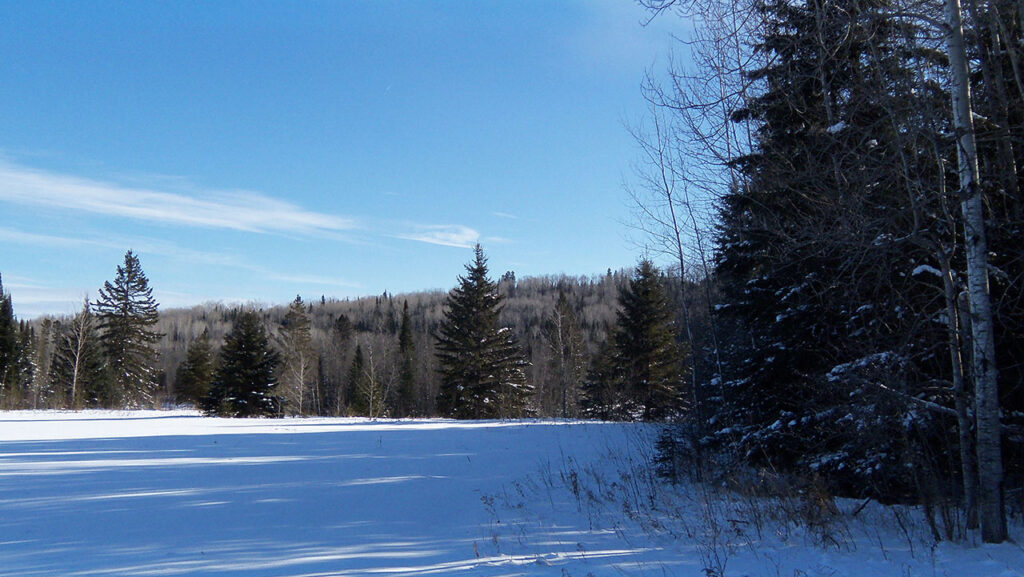
My family now owns a farm in North Western Ontario. It’s not a working farm, more a small collection of ramshackle barns in various states of disarray, and then, fields. 125 acres of boreal forest trimming four open fields. A lining of rich green spruce trees and elegant white poplar and birch frame a wide open space where foxes slink, deer startle, and hawks circle above, every now and then plummeting to the earth after a vole. In the winter, this shining expanse of white snow ices over so that you can wander atop the drifts, listening for that telling crackle that will sink you up to your thigh. Here and there, dead grass peaks out from this blanket and small tracks offer a sign that even at 40 below, a hidden life is thriving.

Photo taken by Megan De Roover

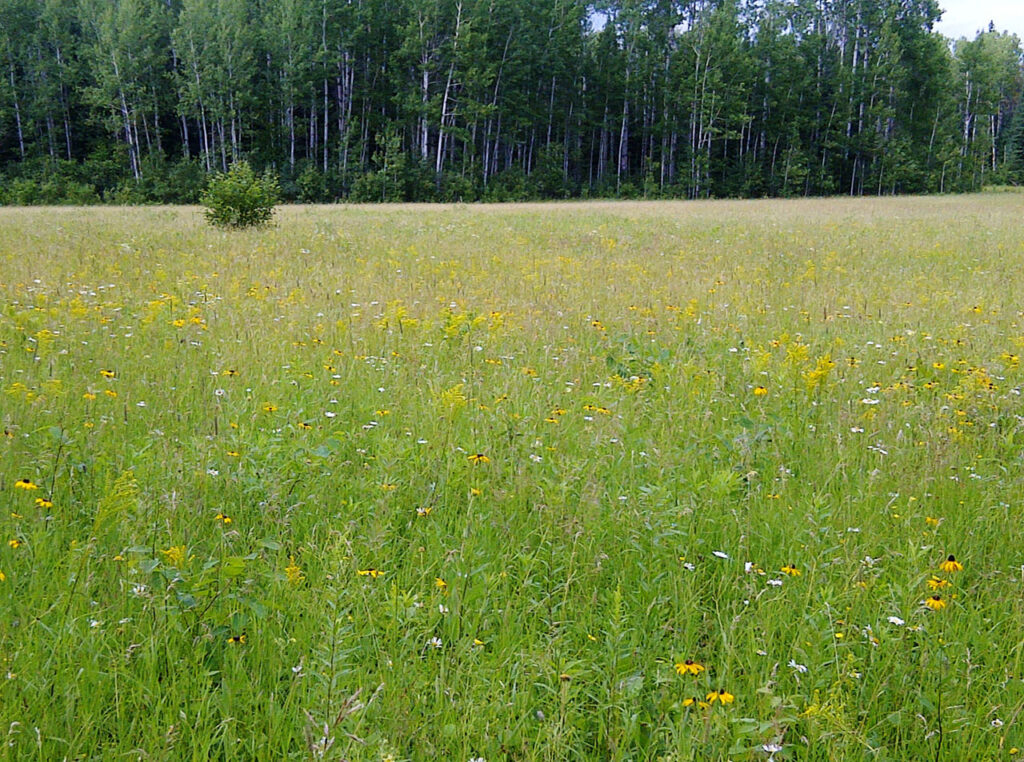
The fields aren’t planted or maintained—unless you include the neighbor that comes every few years to bale hay for his cattle. They’re not homogenous by any means, just residual open spaces where flowers and grasses and grains all intermingle. And where, if you look carefully, on an early summer’s day, you can find tiny wild strawberries deliciously peeking out between strands of green. Day Lilies, Blue Eyed Grass, New England Asters, Devil’s Paintbrush, Birdfoot Trefoil and Daisies of all colours dot the green and gold expanse, and a set of packed dirt tire tracks lead the explorer through.

Photo by Megan De Roover

Even our lawn is multicolored with flowers that my father painstakingly mows around, leaving tufts of Black Eyed Susans along a meandering shorn path leading nowhere.

Now fields might not be the most exciting thing about the “great white north”—in fact, when we think of fields we tend to think of them as empty space, defined by their lack. But this place was alive in ways I’d never experienced. Staying in one place for longer than a year or two offered me a whole new world of watching. The rapidity of travel and the vast distances that I covered at frequent intervals in my childhood had left me a bit lost. Extended travel by plane shifts your perception of time because of how the body “does not move but is moved” (Solnit 28). It wasn’t until I had the time to start walking that I was able to begin re-scripting the spaces where I lived, and engaging with them in a more meaningful way—noticing for the first time the details of the local environments, the weeds coming through the gravel driveway as distinctive species. Rebecca Solnit argues that being moved rather than moving creates a division between the embodied understanding of place and where one is. But then, from this Canadian wilderness on the edge of the largest fresh water lake in the world, I came to Arizona. I’d visited before, but this move was different.

I arrived at my new apartment with only a handful of photos and an email correspondence. I’d selected it for two reasons, the first being that while dozens of other apartment blocks wouldn’t give me the time of day, this complex was comprised almost exclusively of international students attending Arizona State University. The other reason was that while perusing online photos of residences with my mother, we’d both exclaimed “oh look! Green!”

Photo by Megan De Roover

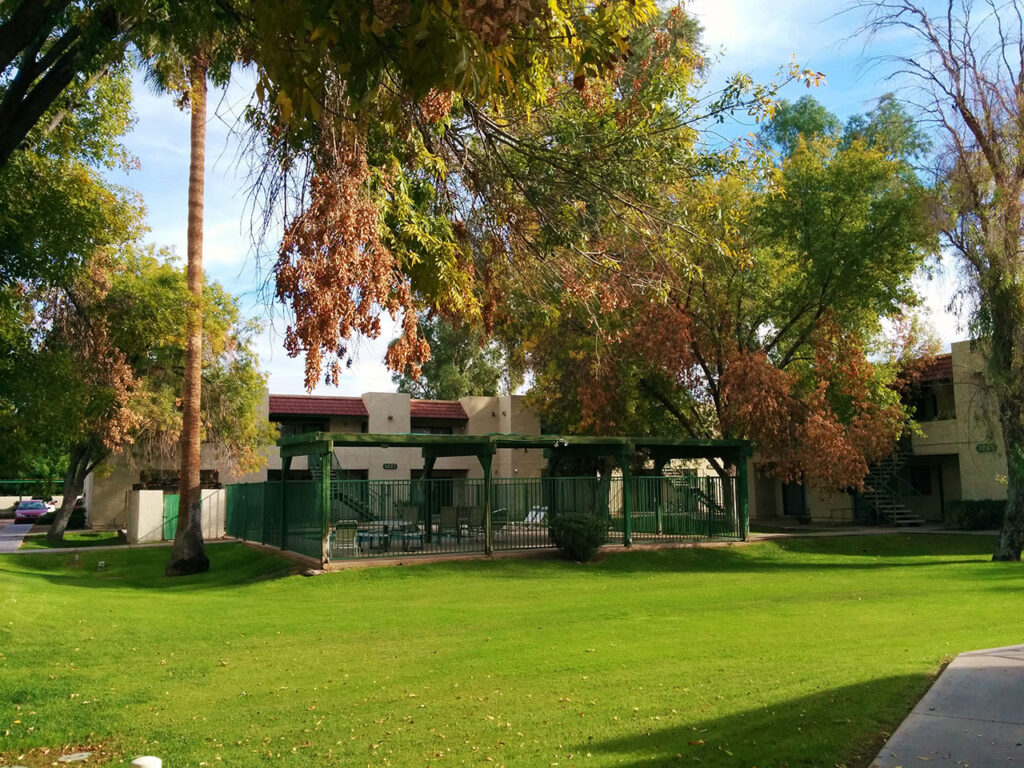
A patch of green lawn and a few cotton wood trees immediately made this place my new home for the next several years. Somehow, as long as there was a little bit of green and a little bit of water, the transition to come here felt easier—even though my objective and sustainability-oriented mind conflicted with my desires. I longed for green while in the desert: wasn’t this at odds with my values? Shouldn’t my aesthetic appreciation shift according to location? I like the way the desert looks and feels, but I can deny the comfort seeing that green patch gave me upon my arrival.

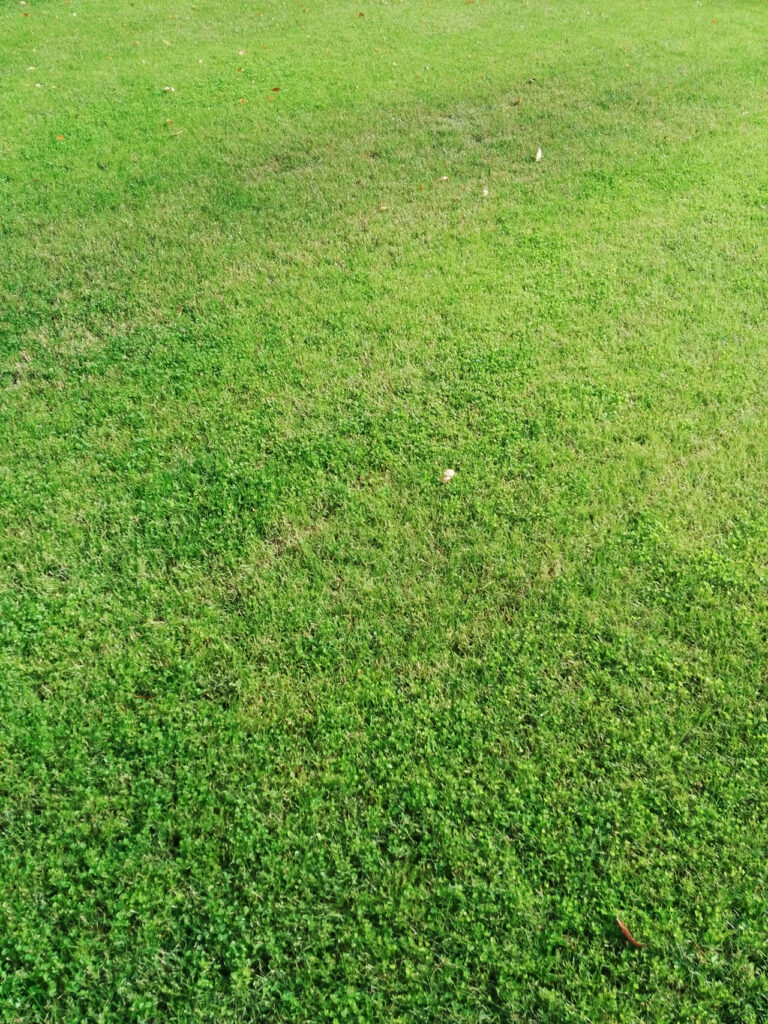
In addition to this discomfort raised by my own longing for green, I found out that bermudagrass, the species commonly used for lawns in this region, is an invasive species, first arriving in the Americas in the 1750’s through contaminated hay used for bedding in ships on the transatlantic slave trade (Kopec). It is a guilty pleasure, seeing it through my window and walking over its dewy blades each morning, knowing that both it and I share a contentious relationship when it comes to belonging and this place. After learning more about its scientific background[i] (which you can locate by scrolling down) it became important to me to find the local grasses of this region and to see how the invasive and the indigenous interacted.

When I’d set out to find an indigenous grass, I assumed that it would be a fairly simple task to locate it. After all, grass is ubiquitous, isn’t it? Everywhere in the Phoenix valley there are green lawns of bermudagrass and Winter Rye grass, as well as ornamental fountain grasses decorating most neighborhoods. I naively thought that some indigenous grass would make up the background scenery on which these foreign species were foregrounded.

I underestimated the skill of bermudagrass in populating this area. It has a mind of its own, like the species in Michael Pollan’s The Botany of Desire, which have gained global control by feeding our human desires for sweetness, beauty, intoxication and control (apples, tulips, cannabis, and potatoes, respectively). Where would grass fit into this scheme? Perhaps beauty, since it has come to define urban aesthetics through the invention of the lawn, or perhaps control—of the local environment, and of our movements. “Keep off the grass” signs dot this country, shaping our movements until, as I’ve noticed, we avoid walking on grass out of habit. Lawn grass has rooted itself in the American psyche, shaping urban design more than we give it credit for. Not only this, but lawns have come to stand as a framing device for how we define our homes; lawns are a luxury and a structure to how we define home. Variations on this lawn motif greatly impact how we see ourselves. After all, the neighborhood policing that goes into lawn maintenance certainly says a lot about how we interpret the people around us.

Lawns, as an ideal, must be a particular color, free from weeds, neatly maintained by largely unseen workers, coming together to tell a story of environmental control and wealth. In many residential districts of Phoenix, home owners are required by law to appropriately maintain lawns in order to adhere to the neighborhood aesthetic—a feat that requires considerable time and money to mow, water, and reseed when the weather gets too hot or cool for that species. As Robert Nixon says in his book Dream Birds, “desert money is a universal currency: it is always blue and green” (74). In this book he talks about the first introductions of bermudagrass to this region, primarily through Alexander John Chandler’s introduction of lawns for golf—a sport previously played on the dirt in this area. Interestingly Chandler was responsible for creating the aesthetic maintained today in the Phoenix metropolitan area largely because he wanted to draw on a tourist base from his home country of Canada. When I’d first read this, I was stunned. It was as if the appeal of the green lawn at my apartment had been deliberately constructed to draw me here. Admittedly there were many other factors resulting in my move, but the coercive lure of grass played a larger role than I was at first willing to admit. Once I learned about bermudagrass–memorizing its distinctive growing structure so that I could spot it even after the lawn mower had its way–I could see the wide distribution everywhere.

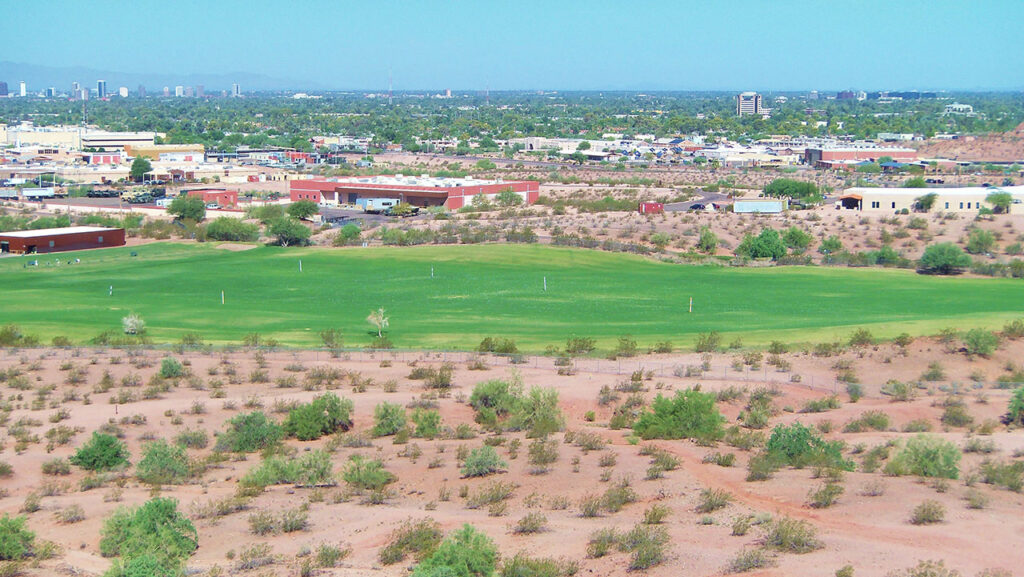
I set out to find an indigenous grass (with no particular variety in mind) in order to study the local to the invasive. Unsettled by the manipulation I felt at the hands (Blades? Roots?) of bermudagrass, I longed for something less controlled. This was nearly impossible—an outcome I hadn’t considered. Almost everywhere that indigenous grass would otherwise be located, invasive species had taken over, due to human efforts or otherwise. The problem was being able to find native species in this desert of homogeneous lawnscapes.

Everywhere I looked, all I saw were the invasive species of bermudagrass and its ilk. At first, I blamed the bermudagrass. How dare it take over the territory by horticultural conquest? Frustrated, I walked about the neighborhood glaring accusingly at these neat lawns, stomping past them on the sidewalk, searching for something else. I had to admit, however, that as frustrated as I was, both this lawn and I shared something. We are both immigrants to this place, sharing the title of invasive species. Elizabeth Kolbert argues in her book, The Sixth Extinction, that having invasive behaviour is both our best and worst trait as humans. Although we might not like to think of ourselves this way, it is evident that humans are one of the most invasive species on the planet. We have spread across the planet, displacing other species and colonizing members of our own, and not only have we done this, we’ve done it with gusto. Whatever it might mean for other species’ survival, ours has been ensured by this practice. As I wandered through the suburban lawns of Tempe, the bermudagrass passing by my feet, I saw a reflection of myself. I did not find any indigenous species of grasses on that day, nor have I yet in my neighborhood.

Kolbert has an article in the New Yorker called “Turf War” in which she questions why the West has such an obsession with the particular aesthetic of the suburban lawn, explaining that “over time, the fact that anyone could keep up a lawn was successfully, though not all together logically, translated into the notion that everyone ought to” (Kolbert n.p.). The sweeping proliferation of lawns certainly attests to this statement. I mentioned this article to my partner, Sven, an environmental engineer in Canada, to which he responded, “Turf war? Like rival gangs?” Even though the play on words is amusing, I started to wonder what it would be like if the actual grasses were the rival parties fighting over territory.

I asked Sven, “Can you imagine if they were rival gangs? What they would say?”

“Grasses can’t speak,” he replied.

But grass speaking isn’t such an outlandish idea if you consider than many indigenous cultures have sacred plants that are given voice in stories. It’s only in the strictly scientific model that the thoughts and expressions of plants and animals are disregarded—a model that is significantly lacking because of this restriction. We learn so much from the exercise of listening, whether this is through imaginary or literal conversation with other beings. While I have no heritage of stories with grass as the protagonist, I could still imagine what that might be like. Combining turf wars with the recent invention of twitter wars, I speculate it could go something like the following. First, let’s meet the characters.

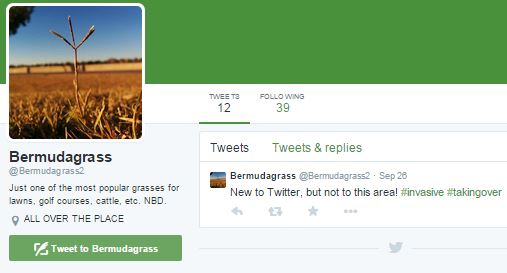
There’s Bermudagrass:

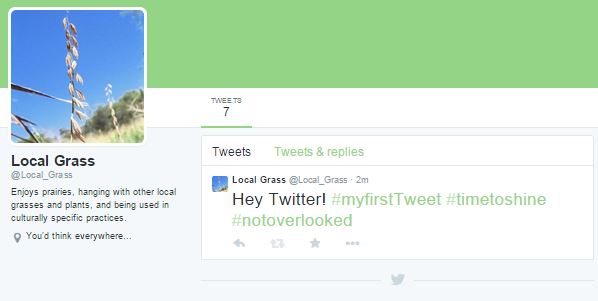
And then a LocalGrass:

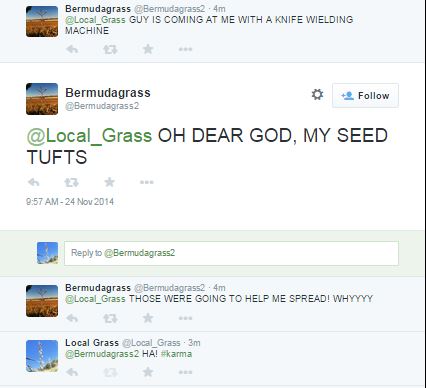
And their conversation might go something like this:

While this is overly simplified, the similarities between outside conquests over indigenous territories in grasses and humans are unmistakable. Even now, golf courses spread out over territory originally belonging to the various first peoples of North America, often provoking land claim disputes. One of the most well-known disputes would be the Oka crisis in 1990 which took place between Mohawk people and the Quebec town of Oka. It was spurred on by the townships plan to expand into territory traditionally held by the Mohawk by creating an expanded golf course and residential housing development. There had already been earlier legal contestation over the original nine hole golf course but “authorities and the courts dillied back and dallied forth, and in the meantime, the developers went ahead with the construction of the course, and happy golfers began roaming up and down the fairways in their little carts” (King 233). And the area on which this golf course and its expanded 18 hold version would occupy? A sacred pinewood grove and an ancestral burial ground. While Tom King’s The Inconvenient Indian: A Curious Account of Native People in North America is primarily about indigenous peoples, the issues surrounding land claims in his chapter “As Long as the Grass is Green” is the principal source for all social disputes in North America. The fundamental difference for King is that “land has always been a defining element of Aboriginal culture …[so] land is home” while “for non-Natives, land is primarily a commodity, something that has value for what you can take from it or what you can get for it” (218). While he admits that this might be a gross generalization, societally it rings of truth. Just look at the circumstances of the Oka crisis with sacred land being traded in for golf courses. Even as I disparagingly shake my head at the colonial legacy of land as an inanimate object I can once more recognize myself—or at least, the comfortable privilege granted me by such a historical trajectory—in it. But maybe there is something more to this idea of “land is home” that could apply more broadly to humanity. After all, I already noted that something about grass makes me feel at home. Maybe recognizing that is a first step towards something.

Even without the violence of land claim disputes, it is obvious who does or does not belong on a golf course. Membership fees, equipment rentals, and dress codes all help to police who is using the sprawling space. Even as this benign lawn expands in otherwise seemingly empty desert, it is clear that there are politics at play that work to maintain an economic social structure.

Photo by Megan De Roover

In Andrew Ross’ Bird on Fire: Lessons from the World’s Least Sustainable City journalist Andrew Kopkind of The New Republic is quoted as saying “Apartheid is complete. The two cities look at each other across a golf course” referring to Phoenix and Scottsdale in a 1965 (Ross 116). Ross’ novel is a critique of the Phoenix valley’s city infrastructure in relationship to water resources. Although grass is not mentioned frequently, it is always present in discussions of water allocation. Charles Bowden, a well-known Arizona author and journalist, wrote his first book Killing the Hidden Waters on the same issues of environmentalism in the South West. Water and grass are never far from each other in these conversations, although, for the most part, the grasses being critiqued are the invasive lawn or turf grasses. Centering on the golf course, it’s evident that the homogenous expanse of invasive grass is a barrier, socially and ecologically, with very real consequences. As Richard L. Duble states in his article on bermudagrass, “The Sports Turf of the South,” “the variety of names given this species attests to its wide distribution and to the fact that it is the object of abuse and scorn … including “Kweekgras” (S. Africa), couch grass (Australia and Africa) [and] devil’s grass (India)” (Duble). The proliferation of bermudagrass as an invasive species used in sporting turf and golf courses produces all kinds of interpretive biases, especially since it is so adept at crowding out other plants (explaining why it is selected for homogenous lawnscaping). But is the title “devil’s grass” really necessary? There’s nothing inherently evil about this species. In fact, it has been incredibly successful in populating the globe–just like humans.

Photo by Megan De Roover

Even as I critique bermudagrass and the golf courses it calls home, there are undeniable benefits which complicate the easy assumption that invasive is a negative name. After all, wasn’t I drawn to that luxurious green to begin with? Didn’t I enjoy watching Inca doves and grackles wander through the emerald blades, hunting for insects or bathing in pools of sprinkler water. Didn’t I love sitting on it with a book, or rolling around with the dog I watch every so often? But aside from personal reflection, there are still scientific benefits. Urban Heat Island (UHI) effect is a very real fact of living in the greater Phoenix area, and interestingly, turf has a useful impact on this phenomenon. As Anthony Brazel explains in an online Arizona Republic article from 2007, “heavily irrigated residential areas are coolest, due to both the evaporating surface water and the shading effect of trees”. Brazel has numerous articles and studies on this topic, all focusing on UHI in Phoenix and potential improvements at policy levels. Interestingly, the residential areas to which he refers are areas like my own neighborhood that frustrated me so much. While I was busy bemoaning the lack of indigenous grass, I overlooked the fact that the grass that is there aids not only my survival in this city, but a whole host of animals that might not be able to endure the heat unmitigated. In fact, I’d overlooked the very thing I’d set out to bring to the foreground—it was a shameful realization.

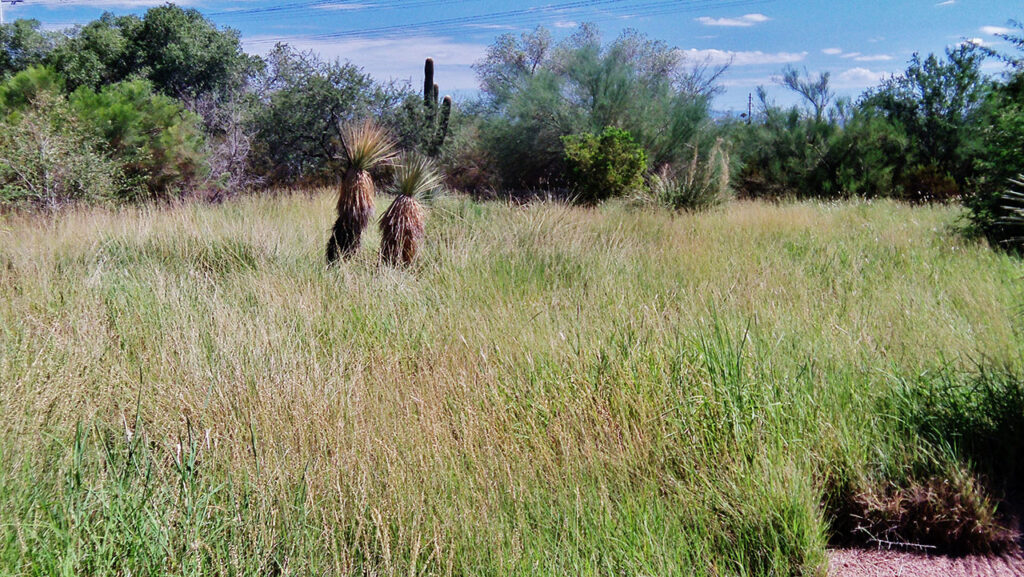
Still unable to find an indigenous species in my area, I set out to escape from the lawns and golf courses to the Phoenix Valley Desert Botanical Garden in search of the elusive grasses of Arizona. I trekked to the Plants and People of the Sonoran Desert trail, hopeful to finally find in this section a variety of indigenous grasses. This was easier said than done. Even though an entire section of the trail is considered Semidesert Grassland, only five plants were labeled, and only one of those five was a grass (bear grass, that while technically a grass looks like a small spikey shrub). While the entire area was covered in three separate varieties of grass, none of them were immediately recognizable.

Photo by Megan De Roover

I gained a new found admiration for these desert (or Semidesert) grasses, particularly for their hardy ability to survive the baking Arizona sun. My plan, when I had arrived, was to sit in the shade and spend an hour contemplating this species with calm, meditative thoughts (starkly contrasted from my frustrated city wanderings). Alas, as picturesque as my communing with grasses had been in my mind, I was rudely confronted with my own bodily constraints. While I sweated through my shirt, vainly trying to replenish my body by guzzling bottle after bottle of now warmed water, these grasses swayed in the barely perceptible breeze, coolly regarding me (I imagined) with a level of disdain. Not only was this a disruption of my somewhat poetic envisioning, I was continuously distracted by the various fauna wandering through the area. I nearly stepped on a mourning dove while walking, and then (to my delight) found an entire family of Gambel’s quail murmuring softly in the underbrush. Even when I had set my pack down and pulled out my notebook, an absolutely stunning Blue Spiny lizard plonked himself on the rock that I had been eying as a seat. As I catalogued these animals, I was attuned to the fact that even in a situation where my undivided attention was supposed to be focused on grasses, I was simultaneously seeking a more anthropomorphic encounter. With renewed purpose, I set about photographing and examining closely the grasses I could find.

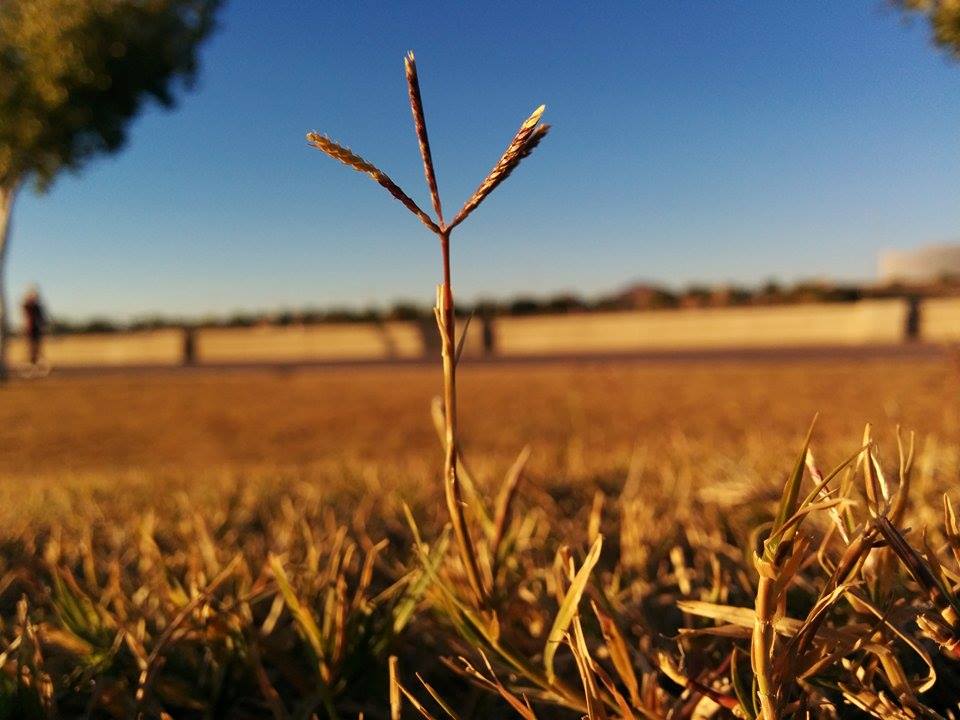
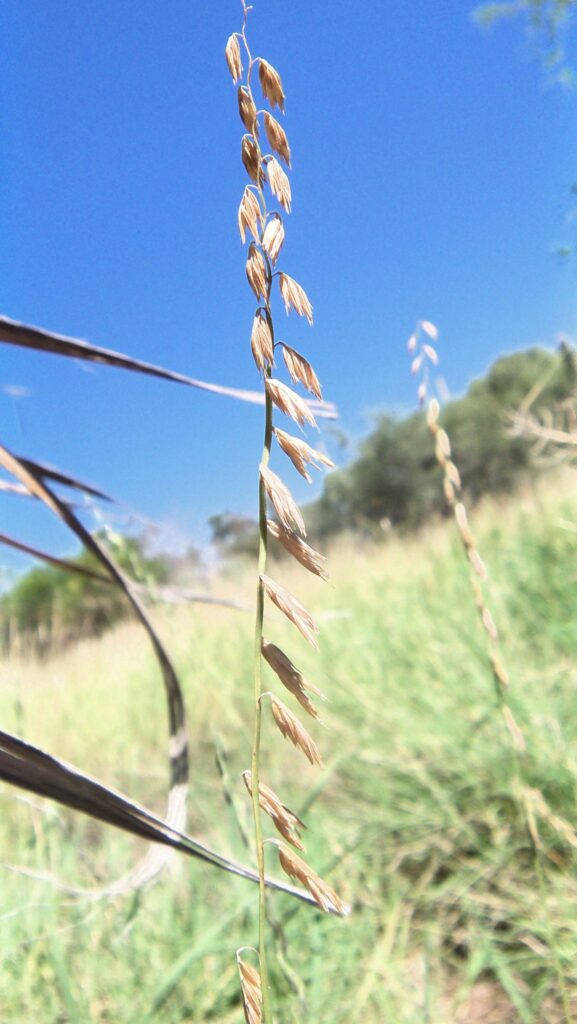
The three grasses in the semi-grass land section all grew mixed in with one another but could be differentiated by the thickness of their blades and stalks, and, more noticeably, their seeding formation, as documented in the images below. Of course, all of these grasses grew together in the same area, intertwined with one another so that upon my first glance, I could not distinguish more than one variety. With further research and the aid of the DBG’s PlantHotline I have now been able to correctly identify each one as indigenous Southwest grasses. As I wandered through the clumps (off of the trail, but careful not to trample the specimens) I began to see the three varieties as clearly as any combination of garden flowers.

Sideoats grama (Bouteloua curtipendula):

This grass has thin bright green blades, of no more than half a centimeter wide, and seed stalks that featured individual tan colored seeds alternating along the flowering culm. The elegant column neatly dangles the seed pods as it stands erect in the field.

Cane Beardgrass (Bothriochloa barbinodis):

Photo by Megan De Roover

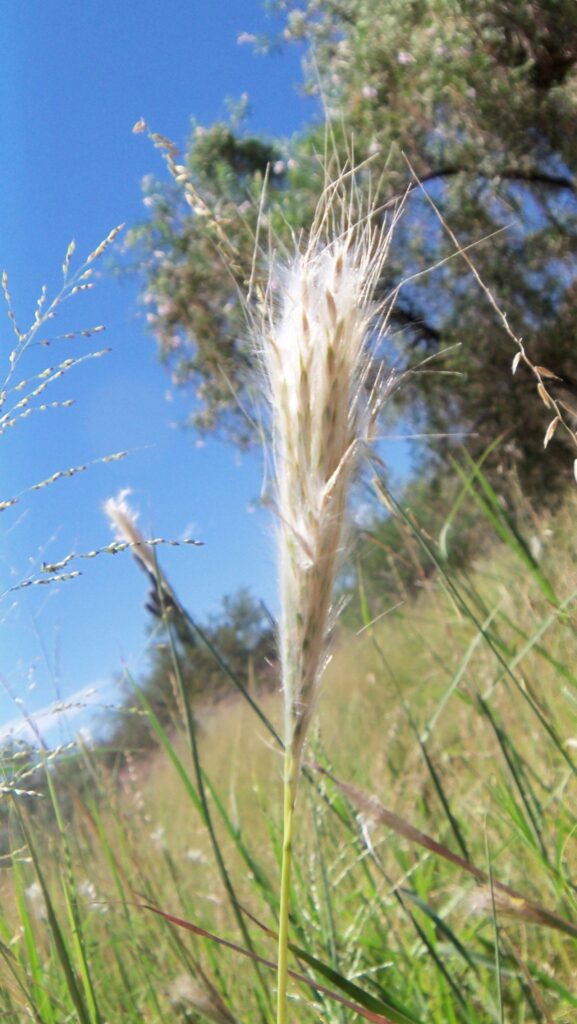
The second grass is considerably thicker, in both the width of the blades and the stems (particularly near the crown, or base) with a deeper shade of green and distinctive fluffy seeds. The light colored seeds immediately catch the eye in the desert sun as bright spots dotting the field, enticing me to feel softness of the seeds and the texture of the stalk between my fingers

Green Sprangletop (Leptochloa dubia):

Photo by Megan De Roover

The third species also has a thicker base stem and was less prolific in the grassland area. The seeds are delicate tendrils, very similar in some respects to the invasive bermudagrass often used in the valley for turf and lawns. The familiarity of this grass was curious because of its resemblance, and yet the differences (such as the height and texture) held my attention.

Because I had no way of immediately identifying these different grasses (I researched and added names and details after the fact), I drew my first associations between them and my memories. Cane Beardgrass brought back the small fluff my pet hamster used to make a nest, and Green Sprangletop conjured a practical joke my mother had used on us kids. My mother, a long time teacher now turned daycare administrator, was the one who instilled in me an appreciation for the environment (as well as the one who bought me my first hamster). As a youth I was constantly dragged from one course to the next, joining organizations like FEEA (forum for ecological education and action) and attending retreats where I was always the only non-adult. Perhaps I didn’t show my appreciation at the time (do teenagers ever do that?) but it stuck with me, and I kept going. Only recently we took nature kindergarten training together in Scotland. But besides being a friend and mentor she was also a trickster, constantly finding the fun in whatever activity we did, no matter how mundane. While walking along the path through the field, she would pluck two seed stalks of a grass very similar to Green Sprangletop and tell us she had a surprise. I remember her leaning in front of me, her eyes twinkling behind large glasses and the shock of white hair that hangs over her forehead, placing the crisscrossed strands between my teeth. “Smile!” she said, and then pulled on either end, seeds filling my mouth and teeth, while she and my brother roared with laughter. I remember it took what felt like forever to get those seeds off my tongue. But it was pretty funny.

While that joke is something I look back on fondly and fully intend to use on my own children, the most visceral reaction I had was when I saw sideoats grama for the first time. Its slender stalk and delicately placed seeds reminded me of the grain fields in the prairies. As a child, I’d spent several summers visiting my Nanny and Papa in the province of Saskatchewan, where so much of the terrain and experience is defined by wheat fields and the prairies. We’d spend most of our time making rounds to farms owned by distant family I didn’t know where, uninterested in the conversations happening at the kitchen table, I’d wander about the fields, running my hands over the tall golden stalks. Once, I convinced my grandmother to let me catch a pair of prairie dogs that would have otherwise been killed by the farm hands. My father built a pen for them and my Nanny—who I imagine will never quite forgive me—had to drive me and the pair of smelly rodents for a full three days back to Ontario. After that incident, my visits were more subdued, though I still wandered the fields. This “Land of the Living Skies,” as Saskatchewan is sometimes called, for me was defined not by the powerful atmospheric shifts that give the province its catchphrase, but rather by those delicate stalks bending gently beneath my palms like spun gold. Well, that as well as the less poetic shrieks that came from my Nanny when she thought one of the prairie dogs had escaped in the motel room.

While Cane Beardgrass, Green Sprangletop and sideoats grama are all worthy of their own individual studies, sideoats grama is particularly interesting. This particular grama grass has significance in multiple cultures for many reasons, ranging from its attractive seed stalk structure to its nutrient content.

Without being able to go directly to elders with firsthand knowledge about this grass, I researched through ethnobotanical databases for recorded accounts of traditional uses and stories surrounding sideoats. The Native American Ethnobotanical Database (NEAD) through the University of Michigan has a convenient listing of recorded uses by anthropologists and ethnobotanists of both indigenous and settler communities. Links to this database and the National Park Services “History and Culture: Grasses, Shrubs and Trees” can be found in the works cited. Both databases offer records of sideoats having been used in medicinal, veterinary, symbolic, and ceremonial uses. I use the past tense here only to refer to these sources as historical archives (the earliest study being from 1939 with the most recent from 1964), since some of the practices are most likely at least partially maintained by the communities in question.

Plains Apaches used sideoats in a “medical procedure to remove cataracts from the eyes” while the Kiowas used it for fodder for their horses. The Kiowa also used the seeded stalks ceremonially to refer to having killed an enemy with a lance due to its “resemblance to a row of feathers hanging along the edge of an Indian Lance” as elaborated by the Encyclopedia of Earth website. The beautiful appearance of the seeds dangling off of the thin stalk that I found so gentle and attractive now associated with violence. Other groups “used dried stalks of sideoats grama to make brooms and hairbrushes” (eoearth.org). In a more romantic NEAD entry, “Young Lakota women searched for four-headed spears of grama grass to bring them good fortune in love and romance,” but according to the National Park Service article, “Only the Lakotas, Kiowas, and Plains Apaches are reported to have had use for these grasses.” I have yet to find a four-headed spear, but Sven assures me that I don’t need to. There is some criticism for these source materials since each story is sourced with an anthropological endeavor—none coming directly from the peoples themselves. There are movements in ethnobotany with focus on indigenous storytelling and culture coming from the communities and peoples themselves, but not much has been published on sideoats.

Most popularly known for its status as ‘State Grass’ in Texas, sideoats is indigenous to a wide area of grasslands in the Americas, ranging from Canada to Argentina. Perhaps I’d even seen it before, ran my hands over its unique seed structure before, a long time ago in the Canadian prairie. Its large seeds feed a variety of wild animals as well as forage for most livestock due to its high nutrition value and its ability to grow in otherwise harsh conditions (plants.usda.gov). Both bermudagrass and sideoats are used in warm season forage, and being perennial come up naturally for livestock each year (aggie-horticulture.tamu.edu). Because of the physiology of bermudagrass, the very reasons why it is an adaptable and useful forage grass are what make it invasive. Its system of stolons and rhizomes quickly crowd out other forage grasses such as sideoats which rely on a different root system, as can be seen in the following diagrams. A deeper analysis of stolon and rhizome systems can be found by scrolling down.

While both grasses serve similar functions in the world of livestock rearing, it’s clearly evident that one is invasive and the other indigenous. The distinct lack of the native sideoats in areas it once profusely populated is indicative of a larger, highly problematic, endangerment of native grasslands.

Ethnobotany and literature could be a means of addressing the endangerment and the preservation of indigenous grasses, particularly through the dissemination of stories. Although grass is more often than naught a backdrop in stories (as well as images, sports—in fact, it’s almost always in the background, we just never talk about it) there are a few examples of grass being foregrounded.

Brian Patten’s poem “A Blade of Grass” exchanges grass as a living poem which he then tries to articulate in a poem himself.

You ask for a poem.

I offer you a blade of grass.

You say it is not good enough.

You ask for a poem.

I say this blade of grass will do.

It has dressed itself in frost,

It is more immediate

Than any image of my making.

You say it is not a poem.

It is a blade of grass and grass

Is not quite good enough.

I offer you a blade of grass.

You are indignant.

You say it is too easy to offer grass.

It is absurd.

Anyone can offer a blade of grass.

You ask for a poem.

And so I write you a tragedy about

How a blade of grass

Becomes more and more difficult to offer,

And about how as you get older

A blade of grass

Becomes more difficult to accept.

An unlikely subject for a poem, the grass Patten is offering becomes a beautiful and poignant critique on how people will often dismiss its beauty, its poetry, while searching for something else. I found myself in this same position before I began to really look at my surroundings and see the grass for what it is: “more immediate/than any image of my making” (Patten).

Grass, an often overlooked backdrop, when brought to the foreground becomes a being of extreme beauty. Sideoats captured the imagination of warriors and lovers in Kiowa and Lakota tribes, while bermudagrass became the art of the elite in landscaping. It appears that grass is in fact a prolific source of art, both in poetry as I’ve just articulated, but also in visual art, sculpture, and performance. In all of these cases, grass is transformed from the mundane into the extraordinary, much like the quote by Henry Miller that begins this article.

Andy Goldsworthy is a well-known British artist based in Scotland who works with sculpture, photography and the environment, making ephemeral visual art in both urban and rural spaces. The works of art themselves (which you can see on his website goldsworthy.cc.gla.ac.uk) are made with natural, often found, materials, and once created and photographed, are left to disintegrate. Some of his most compelling pieces involve grasses woven or grown into intricate patterns, making this simple and often overlooked species an aesthetic wonder. Teaching programs like Voices from the Land bases itself in Goldsworthy’s artistic practice as a way of educating school age children about ephemerality and caring for the environment. When I took this teachers training program in Thunder Bay (this was one of the programs I attended with my mother), it was striking how often we don’t think of our environmental surroundings as art. It was also remarkable how easy it was to change this line of thinking. We spent hours lost in our art making in a small grove of trees and brush near the road side, finishing with a “gallery walk” of all of our creations. The creativity and the excitement was refreshing, and even though this program was designed for school aged children, I think every adult present enjoyed themselves immensely.

Crop circles are probably the most popularized and sensationalized art form that uses grasses as its primary medium. While the grass is usually not the focus of the art, there is much speculation on how grass can be manipulated into creating the massive visual art forms. Whether these designs are extra-terrestrial or a human construction is up for debate, making crop circles the subject of dozens of documentaries, books, horror films, and science fiction novels. The crop circle as art is interesting because it draws a mystical aura of the uncanny and the beautiful to the often overlooked and mundane. The ongoing controversy of the “authenticity” of crop circles offers an unusual platform for discussing grass as an aesthetic and (surprisingly) mysterious art. In documentaries like Crop Circles: Mysteries in the Fields, MIT students create crop circles to explore the mechanics surrounding this peculiar anomaly, while still fulfilling the stereotypical extraterrestrial conspiracy rhetoric in a titillating genre.

English Crop Circle Formation (no copyright)

Not all art surrounding grass is quite as exceptional in terms of its physical transformation of the raw materials as Goldsworthy—who weaves and manipulates grass—and crop circles—which are made up of bent or disturbed grass. Sometimes all that is needed to draw attention to this grass is to place it physically in an unusual place. Performance artist Vaughn Bell’s work “Playing with Plants” offered a transformation of plants by giving them movement. His theory was that by mobilizing otherwise rooted and overlooked beings, we can gain a new understanding of them. Some of his work involved creating plant ecosystems in shopping carts and then pushing these wild grasses around suburban lawns, and others involved placing potted plants on wheels to be “walked” like dogs on leashes. What if we gave plants the same attention that we give to other favourite household pets?

While I don’t think I’ll be taking my house plants out for a walk anytime soon, it does make me wonder what other possibilities there might be to bring these overlooked species to the attention of the public. I imagine that most people are under the impression (like I was when I first began) that indigenous grasses are everywhere, precisely because they don’t know how to identify them, or, only considers grass as a carpeted mass for other, more interesting things, to stand on.

Grasslands cover one third of the Earth’s Land Surface … and The North American prairie is one of the most endangered ecosystems on earth. The grasslands of North America began to form about 20 million years ago, but in some areas up to 99 percent of the prairie has been destroyed (in just the last 125-150 years) (www.statesymbolsusa.org)

The eradication of indigenous species of grass is particularly noticeable in the Phoenix Valley, for even areas where indigenous grama grasses were once plentiful, such as along the Salt River where they served an important function against erosion, they have vanished. The absence of grama grasses creates a deficiency in nutritional foods for animals that benefit more from sideoats than bermudagrass (such as birds). It is a loss that is hidden behind the acres of tidy green squares that define this city.

Even as I revel in the feeling of dew (more likely the automated sprinkler, but dew sounds nicer) on my toes as I walk about my bermudagrass lawn in the morning and fully accept my own appreciation for its uniform greenness, I can no longer interact with it without being acutely aware of how its presence indicates the absence of other varieties. Then again, I cannot deny its own usefulness in my life as it aids in making the summer temperatures bearable. How do I begin to negotiate this complicated relationship that leaves me lost for words? As Lyanda Lynn Haupt writes in The Urban Bestiary,

I absolutely believe that guilt cannot be the highest or even the most efficient motivator. Attending the world more closely, we are inspired to act instead from a sense of love, interconnection, and a recognition of mutual strength and frailty. (305)

Instead of a condemnation of human behavior that improperly pits one species over the other, there should be an emphasis on offering new models of thinking about our relationships with our environments, developing into what Haupt calls “a new nature”. For myself, going through these ethical gymnastics reminds me of the first three rules in Charles Bowden’s rules of the border:

YOU ARE IN THE RIGHT PLACE.

YOU DO NOT BELONG HERE.

DEAL WITH THIS FACT. (Inferno 35)

Like the bermudagrass, I must accept that while I am invasive, I am here. Perhaps my ‘dealing with this fact’ is to “attend the world more closely” and “act…from a sense of love” by continuing to investigate these two grasses that define my living experience of the Southwest and bring the overlooked into sight—whether that species is one that is lost or one that is demonized (Haupt). Perhaps it is to accept a more complicated position that does not resort to a hierarchic dichotomy of good or bad.

If lawns define the aesthetic of the urban spaces I have lived in, what about sideoats? Something about it reminds me of that wilder place, those fields where I learned to grow roots. Something about it offers more than the cut and combed plots of land that are alluring only in their flatness and shade of green. There is texture in the indigenous grass that is perhaps more wondrous because of its sparseness, a pleasure in finally discovering it hidden away on a corner of the botanical garden, and a sadness knowing it once reigned this place.

Chandler’s plan to lure Canadian snow birds to the South West worked—the migration to the golf courses is a measurable shift. And it worked for me when I clicked on that apartment listing. It made me feel more comfortable through the recognizable continuity of green in a place otherwise alien to my ecological experience. It wasn’t this proliferation of bermudagrass that made me feel at home though—after all, home didn’t have neat green lawns. Finding sideoats was like finding home in the desert, achieving what bermudagrasses could not. It was not a tree or a landscape or anything so obvious, but that subtle background, that gentle grass that I’d overlooked until I’d lost it to a sea of lawns.

Grass defines our homes, framing them in blocks of green, carefully marking out our space in the world. But what of that grass that strays beyond our control? What of that species that ranges wild across the prairies? Is it really any better or worse than the one that creeps stolons across the sidewalk despite our best efforts? While I found sideoats to remind me of home and childhood, that block of green which I so readily critiqued turned out to be a lesson in curbing my own divisive thinking. In either case, I cannot imagine home without them.

Photo by Megan De Roover

Works Cited

  • Bowden, Charles and Michael P. Berman. Inferno. Austin: University of Texas Press, 2006. Print.
  • Brazel, Anthony. “Urban Heat Island Affects Phoenix All Year Round.” Arizona Republic. 22 September 2007. Web. 1 December 2014.
  • Crop Circles: Mysteries in the Fields. Dir. John Tindall. Termite Art Productions, 2002. Film.
  • Cudney, D.W., Elmore, C.L., and Bell, C.E. “bermudagrass.” University of California Integrated Pest Management Program website. Np. Nd. 2 September 2014. Web.
  • Duble, Richard L. “bermudagrass: The Sports Turf of the South”. Texas Cooperative Extension. Np. Nd. 2 September 2014. Web.
  • “Excerpts from Killing the Hidden Waters.”The Charles Bowden Reader. Eds Erin Almeranti and Mary Martha Miles. Austin: University of Texas Press, 2010. Print.
  • Gilmore, Melvin Randolph. Prairie Smoke. Bismarck, North Dakota: N.p., 1922. Print. Goldsworthy, Andy. <http://www.goldsworthy.cc.gla.ac.uk/>
  • Haupt, Lyanda Lynn. The Urban Bestiary: Encountering the Everyday Wild. New York: Little, Brown and Company, 2013. Print.
  • “History and Culture: Grasses, Shrubs and Trees”. National Park Service, Web. 8 October 2014.<http://www.nps.gov/wica/historyculture/upload/-14C-Appendix-B-GrassesShrubs-Trees-Pp-891-939.pdf>
  • Kolbert, Elizabeth. The Sixth Extinction: An Unnatural History. New York: Henry Holt and Company, LLC, 2014. Print.
  • Kolbert, Elizabeth. “Turf War.” New Yorker, 21 July 2008. Web. 8 October 2014. <http://www.newyorker.com/magazine/2008/07/21/turf-war-2>
  • Kopec, David M.. “The History of bermudagrass”. Cactus Clippings: 9.1. University of Arizona. Web.
  • Leimkuehler, Ray. Desert Botanical Garden. Plant Hotline Correspondence. September 9-11, Web.
  • Native American Ethnobotanical Database. Dearborn: University of Michigan, 2005. Web. 8 October 2014. <http://www.maquah.net/BritBrn/ethnobotanical/Bouteloua.htm>
  • Nixon, Robert. Dream Birds: The Strange History of the Ostrich in Fashion, Food and Fortune. London: Doubleday, 1999. Print.
  • Patten, Brian. “A Blade of Grass.” Love Poems. New York: HarperCollins, 1990. Print.
  • Pollan, Michael. The Botany of Desire. USA: Public Broadcasting Service, 2009. Film.
  • Ross, Andrew. Bird on Fire: Lessons from the World’s Least Sustainable City. Oxford: Oxford University Press, 2011. Print.
  • Ryan, Courtney. “Playing with Plants.” Theatre Journal. 65.3 (Fall 2013) 335-353. Print.
  • “sideoats grama.” The Encyclopedia of Earth. 12 September 2014. Web.
  • “Side-Oats grama Plant Guide” Natural Resources Conservation Service. United States Department of Agriculture. 12 September 2014. Web.
  • Solnit, Rebecca. Wanderlust: A History of Walking. New York: Penguin Group, 2000. Print.
  • Solnit, Rebecca. A Field Guide to Getting Lost. New York: Penguin Group, 2005. Print.
  • “Texas State Grass.” State Symbols USA. 12 September 2014. Web.
  • “Vegetable Resources” Aggie Horticultural AgriLife Extension. 12 September 2014. Web.


[i] Species Case Study: Bermudagrass

Bermudagrass (Cynodon Dactylon) is a commonly used turf grass in the southern United States. Presumed to have originated from Bermuda, the moniker in fact more likely came into usage because of the grass’s association with the Caribbean and Southern States. Originally imported from Africa around the 1750’s, bermudagrass has been traced to contaminated hay, at that time used for bedding in ships carrying slaves on the middle passage route (Kopec and University of California integrated pest management program website). Since its arrival, it has been used for forage in the cattle industry as well as for lawns (aesthetic and recreational), particularly in areas with higher temperatures and direct sunlight.

Bermudagrass is able to withstand the heat and sun of the Arizona summer with appropriate watering and thus is used as a seasonal grass at Arizona State University and the larger Phoenix Valley. Due to its seasonal coloration a companion grass, Winter Rye Grass, is commonly used in Arizona, replacing the bermudagrass in late September. bermudagrass is perennial and is dormant (turning a yellow-brown) in the winter months while Winter Rye Grass (typically an annual, although hybrids exist) must be seeded every Fall. Through this process of switching lawn species, the aesthetic of year round green grass is maintained in the Phoenix Valley where the temperatures range from 7- 41 Celsius. Bermudagrass thrives specifically in 24-37 Celsius, although it can come out of dormancy in temperatures as cool as 15 Celcius.

The balance between Winter Rye Grass and bermudagrass depends on meticulous attention to temperature, height of grass, sunlight, and watering. For these reasons appropriate maintenance of lawn spaces are rigorously structured. The details of mowing and scalping lawns are intensely documented by lawn maintenance companies. Mowing is only to remove 1/3 of the grass blade at a time, primarily to maintain the aesthetic green color, as well as a manicured height. Because of high light requirements for the physiology of bermudagrass, the seasonal Winter Rye Grass must be physically removed in order to allow the dormant bermudagrass to access enough sunlight to begin its growing season properly. Therefore, a process called scalping is conducted in order to remove as much Winter Rye Grass as possible and to remove the discolored dormant blades of the bermudagrass. Scalping is mowing the grass as close to the ground as possible without damaging the surface hugging stolon system. For bermudagrass the average mowing recommendation after scalping put forth by fairwaylawns.com (to name one lawn maintenance resource) is every 3.8-5 days for a grass height ranging from 1.5-2.5 inches during its growing season. This is additionally done in order to prevent the grass from self-seeding, since during the mowing process the seed stalks are removed. Because bermudagrass is considered an invasive species, unintended seeing can create problems.

Briefly mentioned before, the physiology of bermudagrass is defined primarily by its shoots, known as stolons (above ground) and rhizomes (below ground). Stolons, also known as runners, lie on the soil surface with intermittent nodes on which new root systems (called adventitious roots) expand downwards, creating (effectively) a new grass plant. Rhizomes function as underground root systems that also send up shoots for grass. They move both horizontally (like stolons) as well as in other directions to collect nutrients. Examples of each are strawberry plants (stolons) and ginger (rhizomes). The seeding plant has stalks with two to six spokes at the top and the blades are thin, smooth, pointed, and have small white ‘hairs’ at the base of the sheath. It is exceptionally resilient in the face of high levels of light, heat, saline, and traffic, and so has been used for sports turf as well as aesthetic lawns. According to David M. Kopec, an extension turfgrass specialist, the “specialized growth stems and…relatively rapid growth rate [make this species] excellent at crowding out weeds” making ideal for homogenous lawns. These extending stolon and rhizomatic systems also allow the species to cover a wider area more completely, moving nutrients around from richer deposits to those experiencing a lack. However, for this same reason, it is often considered a weed when not in a lawn space particularly due to its ability to send stolons out over sidewalks and other surfaces.

While incredibly popular as lawn turf (aesthetic lawns, golf courses/sports fields, etc.) the bermudagrass is simultaneously considered an invasive weed that causes serious damage to other crops around the world. Its underground rhizomatic growth structure makes it difficult to remove from commercial crops such as sugarcane, cotton, corn, and vineyards (Duble) making chemical herbicides a common method of eradication. As Richard L. Duble states in his article on bermudagrass, “The Sports Turf of the South” “The variety of names given this species attests to its wide distribution and to the fact that it is the object of abuse and scorn,” “including “Kweekgras” (S. Africa), couch grass (Australia and Africa) [and] devil’s grass (India)” (Duble). In addition to the problems arising from bermudagrass crowding other plant species, the presence of this grass species also changes the surrounding ecosystem, providing a food and shelter source for many different kinds of insects. Duble lists the insects that feed on bermudagrass, including “armyworms, cutworms, sod webworms, bermudagrass mites and Rhodegrass scale (mealybug)” which feed on the foliage, and white grubs that feed on the roots. Insects that live on the grass “include chiggers, ants and ticks” (Duble) clearly make this species a veritable source of food for various urban bird species. Where the grass is left chemically unmodified and un-groomed, the tangles of the stolon can provide shelter even for small mammalians and reptiles (depending on the location and climate).

In Miami, Florida, on the day of August 24th, 1992, my mother and father were expecting their first-born child.

A week prior to this day, the city was receiving warnings of a storm that had originated from a tropical wave over the central Atlantic Ocean. Only days later, it had intensified into a category 5 hurricane that would soon become the costliest hurricane in United States history, one of the most devastating storms known as Hurricane Andrew. As a child, I remember listening to my parents reminiscing about their past, about how this one day had changed the future of our family forever. “Tell me the story,” I would beg my father over and over again. He always began the same way.

http://commons.wikimedia.org/wiki/File%3AHouse_gecko_scan.JPG

“Your mother and I we’re living in a little one-bedroom apartment in Biscayne Bay, close to the water where the storm was most expected. People all around us we’re evacuating from their homes and heading inland.” He would go on to tell me about their close friends, John and Kim, who were stuck in Indiana at the time and were unable to fly back to their home in Florida due to the increasingly threatening weather conditions. John called my father and suggested he take my mother and grandfather to their house that was located further inland to stay safe. Once they had arrived, my father hurricane proofed the house the best he could, nailing plywood to all of the glass windows. “At midnight the storm came,” he would say. He explained to me how the pressure inside a house was different from the pressure outside, and this resulted in what he could only describe as an annihilating explosion. “Everything was chaotic. I took your mother and grandfather into the bathroom where they stayed throughout the night. The noise was frighteningly loud and we could hear glass smashing and things breaking through the walls and windows. There was water pouring in from every crevice and opening. For hours I stood, holding shut a door that was between the living room and kitchen so the rest of the house wouldn’t flood. Exhausted, I decided to try and get through the kitchen and into the garage to get tools to nail pieces of plywood over the door. But once I opened the door my jaw dropped. The entire living room was wide open. The roof had blown off. There were no windows, only open holes through the three remaining walls.”

For a week they were stuck in the house. There was no water or electricity. When they finally got the chance to return to their apartment in the Bay area, they were overwhelmed by the ruinous condition of their once beautiful neighborhood. “We were completely lost. Everything was unfamiliar. I saw a street pole bent into the ground and got out to look at the sign. It was our street. Your mother and I held each other and cried.” My parents had lost everything, a lifetime of pictures and books, their every belonging. They found a place to stay for the remaining weeks not far from their apartment, where my mother soon gave birth to me. My father was working for a company at the time that had just opened up a corporate office in Mesa, Arizona. Once the company found out about my parents situation, left homeless like the 40,000 other families in Florida, they offered him a job there. My mother, father, and I left empty handed, to the place that would become our new home, Arizona.

* * *

The other morning I sat on the patio of my rickety little apartment in the college town of Tempe, Arizona, thinking about this story that I was so captivated by as a child. I thought about how my whole life would be in Florida had Hurricane Andrew never hit the coast. My life would have been completely different had I grown up surrounded by and exposed to such contrasting ecosystems from those existing in the Sonoran desert. As I sat daydreaming, a bird landed on the tall cement wall that enclosed my yard and caught my eye. It had a grey backside that darkened into a black tail, but to my surprise, its belly was a bright, radiant yellow. I watched the winged creature perched on my wall, staring cautiously into my yard. I tried to think of the last time I saw a bird that wasn’t brown, black, grey, tan, or some variation of the four. Before his pictures were lost to the storm, my father was passionate about photography and my grandfather took a strong interest in bird watching. I remember my father telling me about the beautiful photographs he took of all different bird species when he and his father would go out together with their binoculars and cameras. While I have absolutely no bird watching experience, I was intrigued and wanted to ask my father about the colorful creature. I searched the Internet and found it to be either a Western or Cassin’s Kingbird. I hoped to see it again. Perhaps spending my childhood in Florida, around other various types of colorful and more tropical animals, such an animal wouldn’t have completely consumed all of my attention. Maybe I would have grown a different understanding for the incredibly diverse types of urban animals and wildlife that I would have encountered on a daily basis. Maybe the little bird, with the bright yellow belly, would have been overlooked.

In addition to possessing an interest in photographing birds, my father has also always been passionate about other species of life. As a child, he instilled in me a sense of appreciation for learning about all forms of non-human beings. He was the person who I shared the deepest connection with and I was always eager to listen to what he had to teach me, or see what he had to show me. We spent most Saturday mornings contently watching Animal Planet, and anytime he found an interesting program or article related to wildlife, he would share it with me, explaining the parts that I wasn’t yet old enough to quite understand. He was one of the greatest teachers I’ve had, partly because we were such similar people. We were both cautious, observant, and patient, always internalizing our complicated perceptions of life, thoughts that stem from our neocortex and mammalian brains. We had an unspoken connection that he used to keep me curious and thoughtful of the world around me.

School furthered my love of learning. It exposed me to new material that I would have never discovered otherwise. When the time came for the public school system to teach us about Darwin’s theories, I fell into a fascination. I wanted to learn as much as I possibly could about every living thing. I loved how Darwin’s ideas helped me to make sense of the world. One of his quotes in particular always resonated with me. He wrote, “At some future period, not very distant as measured by centuries, the civilised races of man will almost certainly exterminate and replace throughout the world the savage races” (Darwin 193). Now in my adulthood, my love for animals has developed from more than just an interest in finding enchanting little bits of information and facts about individual organisms. It has matured into an infatuation for looking more closely at the non-human species co-existing with us here on Earth. It has become a lens for seeing how wildlife and the natural world have shaped our culture and society throughout time, and how it will continue to influence the future of mankind.

https://www.flickr.com/photos/specklet/355147766/

While I now live on my own as a college student, I frequently visit my parent’s house. They live in Scottsdale, Arizona in the same house that they first purchased when they arrived from Florida. This place had been my home since I was only a few months old, and it holds all of my most cherished memories. As a little girl, I remember swimming in the pool of our backyard and discovering the delicate, floating bodies of baby geckos that had met an early and unfortunate fate. Scooping them into my hands, I would let the water seep through my pruned fingers until I was able to feel the soft, tiny bumps of skin that covered their teeny frames. I would gently lay them in the rocks that lined our desert-landscaped yard, and watch how the sun shone so strongly on their pale, lemon-gold bodies that their skin glowed effervescently. Carefully turning them from side to side, I would squint my eyes and try to get a glimpse at what could possibly be inside such an infinitesimal, alien-like animal. I still find it hard to imagine that the insides of a species so different can even slightly resemble the systems keeping me alive beneath my own skin.

There was one summer day in particular, I was about 7 or 8 and brought one of the drowned geckos into the garage where my father was working on one of his motorcycles. The History Channel was playing in the background. I showed him the lizard. He was the first to tell me that it was a gecko, a type of lizard that lives in warm climates throughout the world. “The families near the lights outside our doors have been there since you were a baby. Supposedly you can hear their calls at night if you listen closely enough.” he said to me.  You can click on the link below to hear the sound made by a Mediterranean house gecko. Sound familiar?

Click on the link below to hear the sound of the Mediterranean House Gecko:

http://www.californiaherps.com/lizards/pages/h.turcicus.sounds.html

“We’ve descended from reptiles over millions and millions of years,” he informed me. Even today, we still share characteristics with the closet living relatives to dinosaurs. I learned that part of what makes up the human brain is the reptilian brain. This is the most primitive structure that we share with reptiles and birds. It keeps us alive when we’re sleeping, regulates our heart and breathing rates when we engage in physical activities, and allows us to breath and digest without constantly thinking about doing so (Deming 177). In her book, Zoologies: On Animals and the Human Spirit, the well respected American poet and essayist, Alison Hawthorne Deming writes, “We are all feral children – beneath the art and invention, beneath the emotion and connection – a reptilian brain, alien and necessary, buried in the mythic and material depths of us all” (177). In a sense, our species is a compilation of those around us. Looking back at this moment and learning from my father about the family of Mediterranean house geckos that are our neighbors, I am left reflecting on our differences and similarities to the animals that live alongside us, and how our lives influence one another. It is our socialness and family ties that give meaning to our lives. My geckos may not share our mammalian brain, but does their reliance on one another give meaning to their lives, too? You can watch the incredible video below of a gecko saving his mate from a near death, and think about this question.


https://www.youtube.com/watch?v=n4JBeUV6uvk

Long before man, the world was undergoing a number of major changes that altered the core composition of our planet. Change has been a constant in the history of all things. Today, I can’t help but wonder if I would have had a similar experience with the geckos if my family had remained in Florida, as the Mediterranean house gecko was, in fact, first reported in Key West in 1915 (Bartelt). Would I have discovered them in my backyard and curiously contemplated what connections creatures so different as human and lizard could ever share? As time passed, I began to grow into a completely different person from the little girl I once was. I was faced with the daunting task of growing up, making friends, fitting in, learning how to grow into the best self I could be. Life suddenly became more complicated and the geckos slowly settled into the back of my mind. I have realized that day-by-day my curiosity for the community I’ve grown up alongside has diminished, and night-after-night I pass by the family of Mediterranean house geckos above the door to my home without so much as a glance in their direction. I’ve become so accustomed to having them there that as my own life became more complicated throughout middle school, high school, and now college, I never really took the time to find answers to the imaginative questions I once had as a child. Reflecting on our history, however, is a provoking way for thinking about how much we share with even the tiniest living creatures.

Both science and cultural traditions can teach us that geckos and humans have expanded to explore territories that are far from, and immensely different from our homelands. Similar to humans, Mediterranean house geckos have proved themselves as pioneers of the Western frontier. As we set out on voyages to discover the new world, all different forms of life followed, and like us, many of these creatures flourished. As these new landscapes became more familiar, we made our homes and reproduced, generation after generation. Our families grew and establishments were made, and so we continued to spread, making both humankind and the Mediterranean house gecko go down in the books as an “invasive species”. Elizabeth Kolbert, author of The Sixth Extinction: An Unnatural History, explains the term invasive species as introduced organisms that not only survives, but also “gives rise to a new generation, which in turn survives and gives rise to another generation. This is what’s known in the invasive species community as “establishment”” (201). While it is impossible to determine for sure the frequency of this event, many established species likely remain in the area where they were introduced, or they often go unnoticed. The third step of this invasion process, which a number of species go on to complete, is spreading to new locations (Kolbert 201). In many places we find ourselves, we find geckos; not only native geckos, but also various types and breeds that, like many human families, have left behind their ancestors in search of a better future. Whether we associate them with good luck or bad, knowing their history can help us to see how inherently intertwined our lives are with the past. They can help to remind us of how far we have come and how.

http://mrg.bz/Zh42fC

Like humans, Mediterranean house geckos have historically proved themselves historically as pioneers of the Western frontier. Conservation of this species is of low priority as its range and population are increasing. They are known for their rapid breeding abilities and strong resistance to pesticides. The Encyclopedia of Life justifies this conservation status by “its wide distribution, tolerance of extensive habitat modification, presumed large population, and because it is unlikely to be declining fast enough to qualify for listing in a more threatened category”. Much like us, they are always finding new ways to progress. The EOL also explains the invasive species status of the Mediterranean house gecko as a “consequence of having few predators in places where they have been introduced, and also of their tendency to take shelter in the cracks and unseen areas of human homes, for example inside walls. Reliance on human habitation has thus contributed to their proliferation, similar to rodents.” The Mediterranean house gecko is a non-migratory species, but is native to the Mediterranean and west Asia. As such successful and rapid colonizers, they have found ways of expanding their distribution with the aid of human activities. The electronic field guide, Gecko Web, refers to the reptiles as “the most successful stowaway of all North American lizards”, as they hitch onto boats, trucks, or planes, helping to explain their wide distribution. Such traits have led to steady populations of this reptile all throughout the Southern United States (Bartelt). For many experts, the mystery of how the Old-World species first made its way to the United States remains. One theory surrounding their arrival is that they were stowaways on a ship from the Mediterranean (Bartelt).

One reason the Mediterranean house gecko is so successful in colonizing new places is due to its rapid breeding abilities and strong resistance to pesticides. Such qualities have led to a low conservation status, which the Encyclopedia of Life (EOL) justifies by “its wide distribution, tolerance of extensive habitat modification, presumed large population, and because it is unlikely to be declining fast enough to qualify for listing in a more threatened category”. The EOL also discloses information about the invasive species status of the Mediterranean house gecko as a result of having few predators in the places where they have been introduced, and also because they often go unseen as they tend to take shelter in the cracks and overlooked areas of human residences. Their reliance on human habitation has therefore contributed to their proliferation, like that of rodents. The Mediterranean house gecko is a non-migratory species and they are native to the Mediterranean and west Asia. Yet, as such successful and rapid colonizers, they have found ways of expanding their distribution in many places throughout the world. The electronic field guide, Gecko Web refers to the reptiles as “the most successful stowaway of all North American lizards.” They find ways to hitch rides on boats, trucks, and planes, resulting in their wide distribution and presence, from Europe all the way to North America (EOL). There are steady populations of Mediterranean house geckos throughout the Southern United States (Bartelt), from my family’s first home in Florida, to my home now in Arizona. While their presence is an indirect effect of human activities, it is also a direct effect of our desires and decisions.

Geckos are highly popular animals in the pet-trade (Bartelt). While I mourn the loss of an intrinsic sense of curiosity that came so naturally to me as a child, I observe this inspiring quality in the children that I help care for as a nanny. Elle, an 8-year-old girl, has had numerous pet rodents, like gerbils, hamsters, and mice. She prefers critters that are a bit more furry and fluffy, like her pet ginuea pig, Sparkles. 5-year-old Will, on the other hand, is saving up for his own first pet – a gecko. Not long ago, he enthusiastically handed me a flyer of basic gecko care information, and at the top of the page there was a picture of what appeared to be a Mediterranean house gecko. Will also exclaimed that he would get crickets as an added bonus to feed his new friend. When I returned home that evening, I turned to Google to briefly research the Mediterranean house gecko as a pet. I came across a number of inquiries from the general public asking if they can be used for pest control purposes. After reading a few discussion forms, I found one woman motivated, like many others, to invest in a house gecko because she’s heard that they “are a good method of dealing with roaches”, and, she adds, “they’re kinda cute”. Another comment was from a woman saying that she recently moved states and the amount of insects around her home appeared to be much higher. She explained that she used to have geckos on the walls of her old house and believes that they drastically helped limit pests and other insects. She thought they could now be useful in her new home as well. Bringing in nonnative species, however, can interrupt the balance of the current eco-system.

Commonly overlooked species and their presence, like the gecko’s, may not outwardly appear to affect the balance of the eco-systems around our homes, but it is our responsibility as a species sharing this Earth with other forms of non-human life, to understand that each and every living creature plays a valuable role in making the environment, as well as our societies, function in a way that is both healthy and necessary. It is important both culturally and environmentally to appreciate and accept the diversified parts of the world for what they are. In doing so, we are also able to observe and admire how the earth is home to so many different and unique ecosystems. Many of our families may have traveled far from where they began, and we should embrace the diversity of life and see the different and unique regions of our planet’s differences as a reminder of the past and an expression of our present and future. Together, humanity and wildlife have traveled incredible distances, each shaping the world into what it is today.

Taking a step back and looking into our past can help put into perspective our place in the world. We can rediscover the ideas surrounding man and the natural world that have played, and still continue to play, an important part in helping us understand every species place in relation to one another. Today, our time is so often consumed in technology, work, school, and family and social obligations. It isn’t uncommon to suddenly find yourself feeling disconnected to nature and distanced even from the wildlife just outside your door. Continuing to possess an appreciation for school and my ongoing college education, I found that historical and cultural works of art and tradition offer an enlightening and grounding way of thinking about mankind and our environment. The stories of so many non-human species alongside the stories of mankind have helped to fabricate everything from our constantly crystallizing societies to our unique cultural values around the globe.

Studies in history, philosophy, aesthetics, religion, literature, film, and media, relating to the natural world have been an integral part in forming the societies of today. Further exploring the interconnectedness between culture and the natural world, Deming, writes “As long as we’ve been human, we’ve been making art. Or perhaps it is more accurate to place this eagerness to participate in creation at the center of what it is to be the animal we are: as long as we’ve been making art, we’ve been human” (8). From the beginning of time, humans have possessed a need for art as an outlet to explore and express our time and place as a society. These forms of art, whether it is through writing or oral storytelling, are a framework for people to share, examine, and question the history of all life that has fashioned the world that presently we live in. Our human cultures are a way for us to braid art, nature, and ideas of what we are, where we are, and where we want to be. Such works provoke us to reflect on ourselves as a species in relation to other species. They call attention to the differences between the human and non-human. They explore the intricate ideas surrounding how we make one another what we are, and how one can never exist without the other.

Some of the most paramount examples of humanity’s place in the natural world stem from the stories of native cultures. The Hawaiians, witnesses of the colonizing capabilities of geckos, associate them with luck. The native people of Hawaii have a great respect for these animals, not only because they are a useful form of insect control, but also because they resemble the “mo’o”, the Hawaiian guardian spirit that refers to a gleaming black, dragon-like reptile. This spirit often plays a role in their creation legends, and it ranks second to the shark (Hawaiian Life). One article I recently stumbled upon on Hawaiian mythology featured in Maui Magazine, further explains the “mo’o, saying, “Dragons. Lizards. Deities. Whatever word used to invoke them, mo’o rank among Hawaii’s most mysterious mythic creatures. They figure into the oldest Hawaiian stories and are a key to a deep, nearly forgotten magic.” In many native cultures, lizards are given the same level of importance and influence as animals that today we would likely think of as being notably more charismatic and symbolically powerful, such as a lion or polar bear. The history of human culture has the potential to teach us that all life, no matter how small or unseen, shapes the way we view the world, in turn shaping the actions and decisions we make as well. Recognizing the powerful qualities found all forms of life, not only those of charismatic species, can allow us to continue enriching our culture, while also bringing attention and awareness to the creatures that are a vital part to our diverse eco-systems and understanding of life.

Before I realized that the curiosity and more observant nature I had as a young girl for the wildlife around me was slowly fading, I can recall one night when I was still in high school that reminded me of the riveting roles that animals have played for so many different people. I was knocking on the door of my best friend, Natasha’s house. Her parents had moved to America from Pakistan, about twenty-five years ago after they were married. Natasha and I had been inseparable since kindergarten, and her family lived in the same neighborhood as mine. I considered her to be a normal, American teenage girl, no different than myself, but her parents were always foreign to me. They were always speaking to one another in Gujarati, their first language growing up in Pakistan. When they spoke English they had a thick accent and uproariously loud voices – something I dismissed as cultural. Natasha answered the door and her mother yelled at me from the living room to come in quickly so no geckos would sneak in. Recently, they had found a few geckos inside the house and thought they must have been crawling in right through the door. “They sneak in without anyone even noticing. Gross, slimy little things. Galori. They make me think of my mother,” Natasha’s mother, Spenta said.

“They won’t harm you,” I told her, used to seeing them each night outside my own doors.

“Yes they will,” Spenta replied. “They have harmed my family for generations.” She went on to tell me the story of how years ago in Pakistan, her grandmother was sitting on the living room sofa when a lizard scampered over the ceiling. “The nasty thing fell from above onto her and bit her in the chest.” About a month later her grandmother was diagnosed with breast cancer near the spot the lizard had left its mark. A generation later, Spenta’s mother also fell ill with the same, grievous sickness. I thought of the day in elementary school when Natasha told me that her mother, too, had been diagnosed with breast cancer, and again when it came back just a few years ago. To this day, lizards represent bad luck for these people, and they believe that these creatures are the reason why the women in their family have been cursed with cancer and forced to undergo such grim and terrifying times. Despite their negative connotation in some cultures, Natasha’s mother’s story is an example the powerful influences of commonly overlooked animals in native cultures and traditions that make us view the natural world and its inhabitants in a certain way. Whether their presence is a blessing of good luck, or a curse of the bad, cultures from all over the world employ legends, stories, and art that can help us see that we are living in a more than human world.

Lizards in native cultures don’t always carry a meaning associated with luck. A Native American tribe known as the Karuk, employs lizards in their stories as symbols to help explain the mysterious origins of the earth. I came across one of their creation legends in the book Spirits of the Earth: A Guide to Native American Nature, Symbols, Stories, and Ceremonies. The author, Bobby Lake-Thom, writes of the tale of a lizard and coyote working together to help make the first babies in the world. The two animals were one day discussing the problems that women were having giving birth and trying to find a solution so that they would not die. The lizard suggests that they should let the baby come out from behind, instead of from her mouth, and says that he will try to help her. The Coyote responds to the lizard in favor of his idea, but says that they should let the first baby be born a female because more good women are needed in the world. The lizard agrees, then says, “but I am going to help make the boy’s hands, feet, and penis while it is still in the woman’s stomach. And since he will then look like me, I will always make sure he is protected and grows up to be a warrior” (149). Similar to the Hawaiian creation legends, the lizard is bestowed with an important role alongside the charismatic Coyote. In this particular story, the lizard is even viewed as a warrior, vowing to protect the unborn. Also interestingly, we can see from this story that in some native cultures humans were modeled after animals. Throughout all time and until today, we can look to old stories and traditions to understand our place in the natural world.

The association of geckos and lizards with luck and positive creation stories, however, is not found in all cultures, as I have already learned from my visit with Natasha’s family, but they can still offer us great insight about ourselves. A chapter from the Kitab As-Salam, The Book on Salutations and Greetings, in the Islamic religion, says, “He who killed a gecko with the first stroke for him are ordained one hundred virtues, and with the second one less than that and with the third one less than that” (Bauer 120). Still today, we are less drawn to reptilian creatures than of more charismatic mammals because we feel so different from them. Lizards often appear portrayed negatively in many poems as well. One amateur poem I came across links our likeness to reptiles in a piece called Reptilia. It reads,

My skin feels like scales

A piano bench

Metronome passing the time

Impatiently

Perfectly

Living like death

Spreading along Petri dishes

And moving forward in octaves

Like a starving gecko

Eating its own tail

To me, this self-expression of art is an example of the common misrepresentations associated with geckos. After all, it is our reptilian brain that is constantly keeping us alive. In addition, it is unlikely that such a successful survivor with a wide variety of prey should be forced to eat its own tail to survive. Yet, it helps us to acknowledge that there is much we don’t know about the animals living around us, or even about our own evolutionary past. Aaron M. Bauer, author of Geckos: The Animal Answer Guide, writes on the luck of geckos that varies each year, “In Sri Lanka there is a long tradition of making predications based on the actions of geckos. Even today an annual almanac is published that contains the sections “predictions based on gecko calls” and “predictions based on the body area on which a gecko falls”‘ (118). These reptiles, no matter what light they are portrayed in, are full of a spiritual power that can still be seen influencing society today. However, we all too often forget to reflect upon the roles that we have given to animals throughout history, roles that help us to make sense of all that exists. Geckos, tiny and commonly unnoticed, have helped humans for a great deal of time to unlock a nearly forgotten magic. This magic, I believe, is a key for looking at our past to see how it has influenced the way we view the world. It can help us adapt a new, positive perspective for understanding the importance of every living being that keeps our planet so balanced. Taking the time to reflect on our cultural history leads to a deeper connection, and a deeper understanding and appreciation for the natural world.

It is through the past that we can gain perspective of what it means to be human in a world that is, and will always be, so inseparably connected to all that is not human. In attaining this sense of perspective, we find ourselves. We become enlightened. We are able to recognize how different life is today than it once way. The past allows us to better understand our place in the present, and we can use this recognition to help us see where are headed in the future. Henry David Thoreau, perhaps one of the world’s most famous philosophers and insightful naturalists, once wrote of the West:

The West of which I speak is but another name for the Wild; and what I have been preparing to say is, that in Wildness is the preservation of the World. Every tree sends its fibres forth in search of the Wild. The cities import it at any price. Men plough and sail for it. From the forest and wilderness come the tonics and barks which brace mankind.

I believe that not only in wildness is the preservation of the world, but also the perspective that humanity, as stewards of the Earth, must make an effort to realize for the wellbeing of all species. This wildness has become the place where we have settled down to have our families and make our lives. Today, we are often lost in the technological and scientific advancements and social constructions that society has weaved into our everyday lives. Wildness disguises itself in the cracks of our walls and the crevices of our homes, but it is always present, and always nearby. It is in our past that we can recapture a sense of wildness so remarkably pure and powerful, to see ourselves, to see our future.

Having lived apart from my family for a few years now, I am no longer greeted each night by a family Mediterranean house geckos. Each time I visit my mother and father, however, in our home filled with the memories of my childhood, I look forward to their welcoming presence. Though they are now a few generations more recent, I know that this will always be their home, too. From time to time, as I am sitting each morning on the patio of my own, makeshift home that is my college apartment, I’ll notice a lizard scamper by and think of my life here in Arizona, the only place that I have been able to call my true home for as long as I can remember. Or perhaps I’ll find myself lucky enough to be visited by a colorful little bird that will make me think of my home that could have been in Florida. I try now, to see more through the eyes of my childhood self, to embrace my own personal past and the past of all humankind. Looking back has helped me to see how far my family and I have come, how far humans and non-humans have come, existing side by side and making life, and what it today, possible for one another. The past has made me the reflective, thoughtful, and spiritual person that I like to believe I have grown to be. The past has brought out the wildness around me.

Deity or Gecko?

Play the video below to watch how a Mediterranean house gecko catches its prey!

https://www.youtube.com/watch?v=qEuBv-2IIoE

Works Cited

  • Bartelt, Amber. “HEMIDACTYLUS TURCICUS MEDITERRANEAN HOUSE GECKO.” Texas Invasives. Texasinvasives.org, 25 Aug. 2014. Web. 15 Nov. 2014. <http://www.texasinvasives.org/animal_database/detail.php?symbol=17>.
  • Bauer, Aaron M. Geckos: The Animal Answer Guide. Baltimore: Johns Hopkins UP, 2013. Print.
  • Deming, Alison. Zoologies: On Animals and the Human Spirit. Minneapolis: Milkweed Editions, 2014. Print.
  • Darwin, Charles. The Descent of Man. Princeton, N.J.: Princeton UP, 1981. Print.
  • “Gecko or Mo’o.” Hawaiian Life. HawaiianLife.com, 15 Apr. 2010. Web. 15 Nov. 2014.
  • Haupt, Lyanda Lynn. The Urban Bestiary: Encountering the Everyday Wild. New York: Little, Brown, 2013. Print.
  • Johnsen, Keith. “Reptilia.” Hello Poetry. Hello Poetry, 6 Mar. 15 Nov 2014.
  • Kolbert, Elizabeth. The Sixth Extinction: An Unnatural History. New York: Henry Holt, 2014. Print.
  • Lake-Thom, Bobby. “Reptile and Snake Signs and Omens.” Spirits of the Earth: A Guide to Native American Nature Symbols, Stories, and Ceremonies. New York: Penguin Group, 1997. Print.
  • “Mediterranean House Gecko (Hemidactylus Turcicus).” Encyclopedia of Life. Encyclopedia of Life. Web. 16 Nov. 2014. <http://eol.org/pages/456655/overview>.
  • About
  • Observatories
  • Resources
  • Food Futures
  • ExhibitsNew